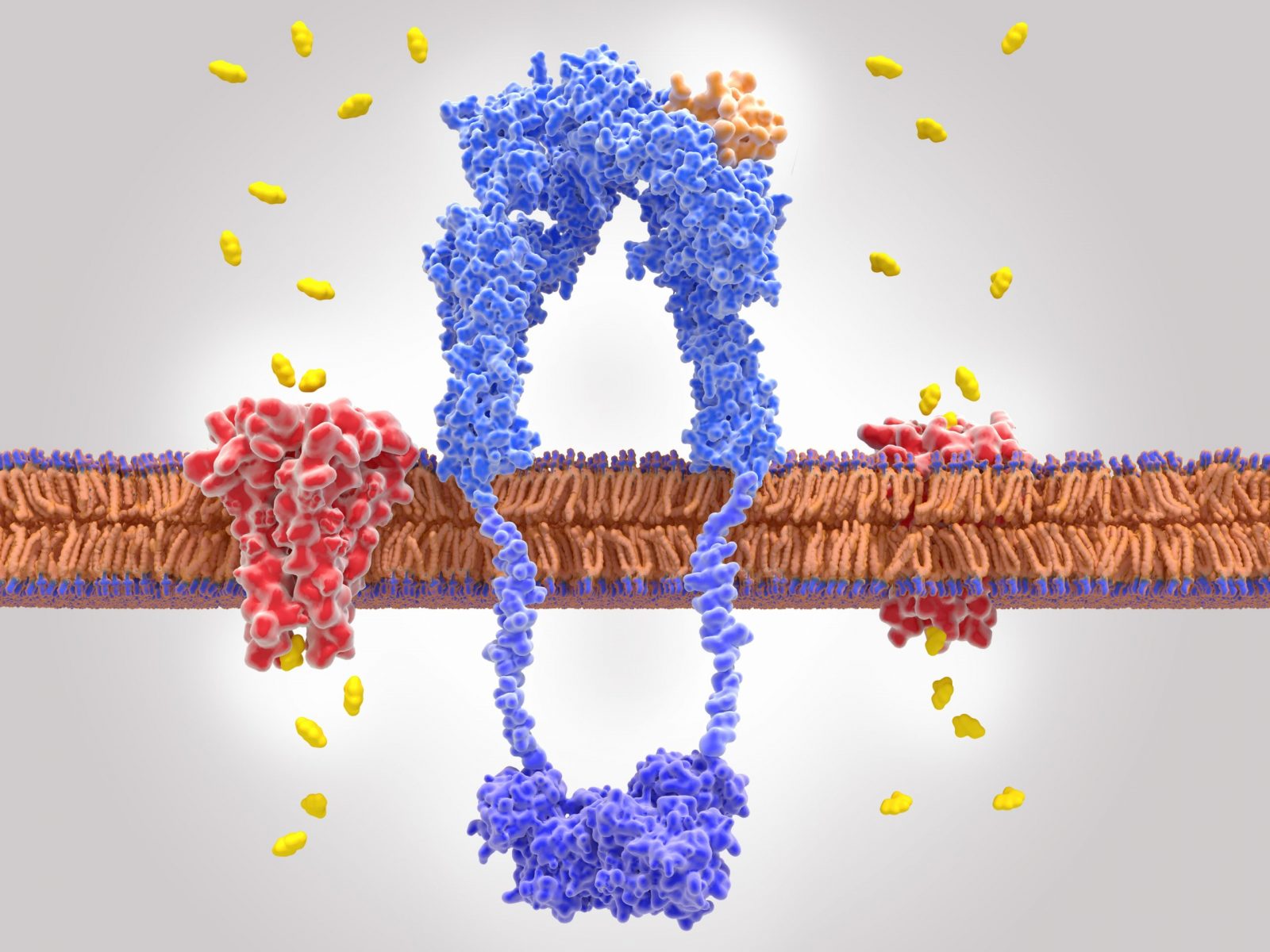
Binding of insulin to the insulin receptor leads to glucose uptake into the cell
The insulin receptor (blue) is a transmembrane protein, that is activated by insulin (orange). Insulin binding induces structural changes within the receptor which activates a signal cascade leading to the transport of glucose into the cell mediated by a glucose transporter protein
ID the Future Intelligent Design, Evolution, and Science Podcast
Share
Facebook
Twitter/X
LinkedIn
Flipboard
Print
Email

Glucose Systems in the Body — Another Instance of Irreducible Complexity

Guest(s)
Howard Glicksman
Duration
00:23:08
Download
Audio File (32 mb)
Share
Facebook
Twitter/X
LinkedIn
Flipboard
Print
Email

Dr. Howard Glicksman, author of an extended series at Evolution News on “The Designed Body,” is interviewed on a classic episode of ID the Future by Ray Bohlin on glucose, glycogen, glucogon, insulin — all part of an extended multi-step series essential for life — an irreducibly complex series.

“If students only knew how life worked,” says Dr. Glicksman,” … they’d quickly come to realize that when it comes to figuring out where it all came from, common sense tells us it was intelligent design, and it’s the Darwinists who are suffering from an illusion.”

Howard Glicksman

Dr. Howard Glicksman is a retired general practitioner who received his medical degree from the University of Toronto. He was a primary care physician in the office and hospital setting for almost 25 years. He then provided medical management in the home for terminally ill hospice patients for the rest of his career. He is the author of “The Designed Body” series for Science and Culture Today. Glicksman further develops the arguments from this series in a book co-authored with systems engineer Steve Laufmann, Your Designed Body (2022). He contributed to the YouTube video series Secrets of the Human Body and co-authored Your Amazing Body.
Tags
Intelligent Design
irreducible complexity
The Designed Body