Is the intelligent design movement a short-lived phenomenon that has come and gone? Or is its steady and consistent growth evidence of a flourishing scientific program? On this ID The Future, host Andrew McDiarmid concludes his conversation with Dr. Casey Luskin about his critique of a recent book called Designer Science that portrays the ID movement as a short-lived political, cultural, and religious phenomenon that has produced little new research in the last two decades. In Part 2, Luskin turns to another major problem: Designer Science almost entirely ignores the last twenty years of ID scientific research and novel arguments. As the book gets retracted by the publisher, Luskin corrects the record in this conversation. This is Part 2 of a two-part conversation. Read More ›
If theistic evolution doesn’t work, and Darwinian evolution is scientifically inadequate, what alternative framework better explains the origin of life and the universe? On this ID The Future, host Andrew McDiarmid concludes his two-part conversation with Father Michal Chaberek and Steve Greene, authors of a new book called Creation or Evolution? A Catholic Dilemma.
In Part 1, the discussion centered on why evolution became a dilemma for many Catholics. Part 2 explores the obvious follow-up questions: what does modern science actually reveal? Does the evolutionary story satisfy the evidence? And if not, what is the more adequate explanation? Fr. Chaberek and Greene review just a few of the many lines of scientific evidence suggesting that a Darwinian process in wholly incapable of producing life as we know it. Read More ›
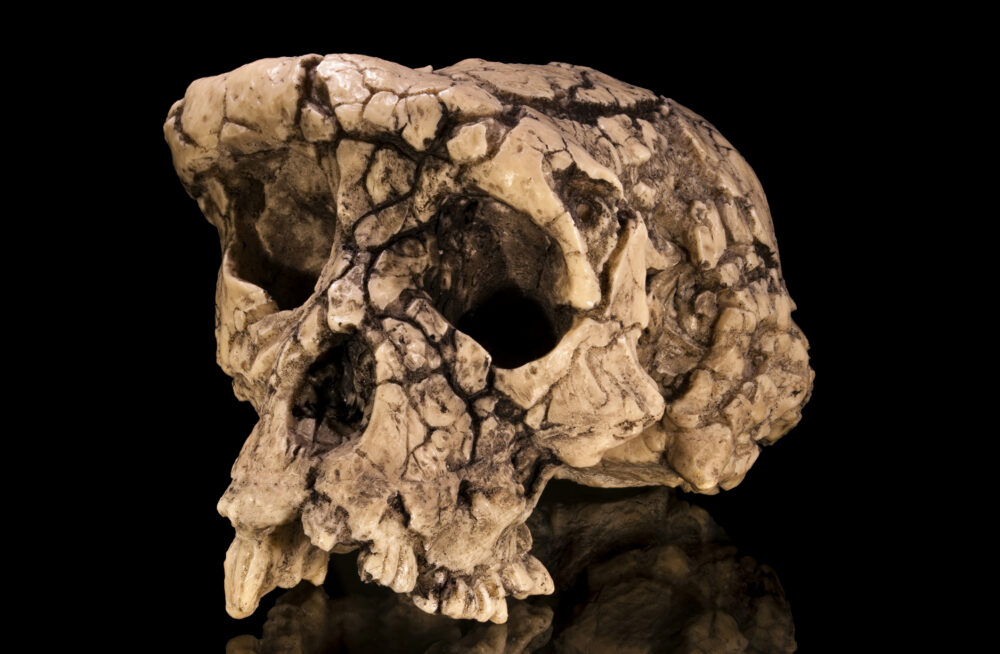
How do you separate the facts from the narrative? That can be challenging these days, and the realm of science is no exception. On this ID The Future, enjoy the second half of a conversation with Dr. Casey Luskin that originally aired on the Come Let Us Reason Together Podcast hosted by Lenny Esposito. Casey discusses the growing controversy surrounding Sahelanthropus tchadensis, a fossil often described as one of the earliest human ancestors. But what began as a celebrated evolutionary discovery has now sparked open disagreement among evolutionary scientists themselves.
In this concluding segment, Casey will discuss the telling researcher-to-specimen imbalance in the field of paleoanthropology, the nuance between error and deception in human origins narratives, and the broader implications of the controversy around the Sahelanthropus fossil. This is Part 2 of a two-part conversation. Read More ›
Science is a very human enterprise, and very human problems can color scientific research as well as the narratives cast around findings and results. On this ID The Future, we’re bringing you the first half of a conversation with Dr. Casey Luskin that originally aired on the Come Let Us Reason Together Podcast hosted by Lenny Esposito. Casey discusses the growing controversy surrounding Sahelanthropus tchadensis, a fossil often described as one of the earliest human ancestors. But what began as a celebrated evolutionary discovery has now sparked open disagreement among evolutionary scientists themselves. In this segment, Casey reviews the history of paleoanthropology, what the field is trying to prove about human origins, and how language, bias, politics, prestige, and funding pressure all play a part in how discoveries are framed and evidence is weighed. This is Part 1 of a two-part conversation. Read More ›
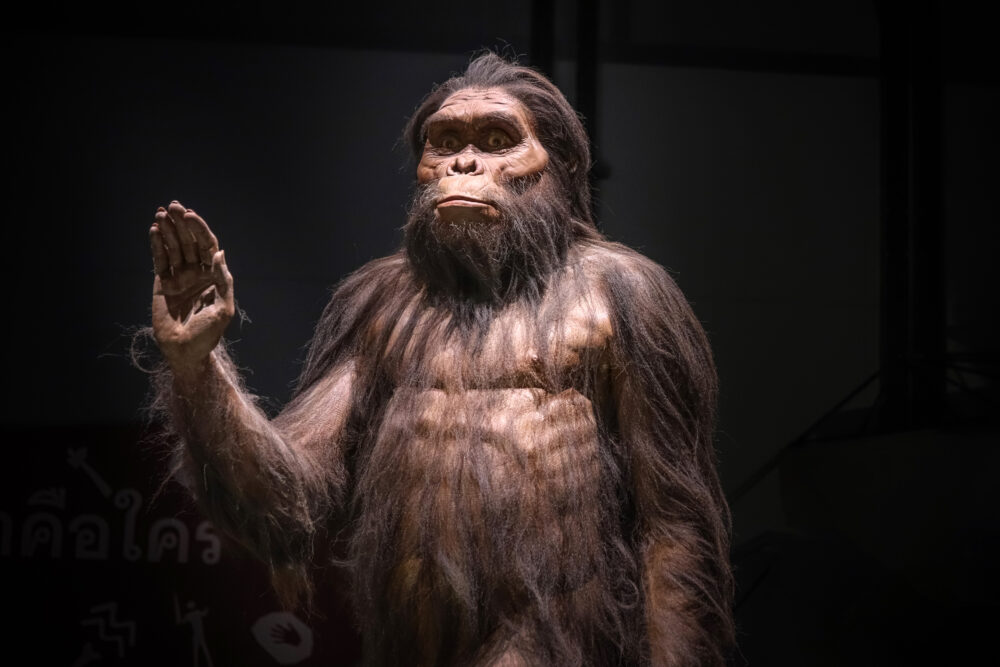
Bangkok, Thailand - November 13 2020: Australopithecus at Rama9 museum, Australopithecus afarensis is an extinct species of an early human
God of the gaps. Lucy as human ancestor. Co-option to explain away irreducible complexity. Perhaps you've heard some of the most common objections to intelligent design, but do you know how to adequately respond to them? On today's ID The Future, geologist and lawyer Casey Luskin explains how to refute these and other objections to intelligent design as he concludes a conversation with host Jacob Vasquez that originally aired on the Truthful Hope podcast. This is Part 2 of a two-part conversation. Read More ›
Sometimes, it’s good to go back to the basics. Whether you’re brand new to intelligent design or you’re looking for a way to share the basics with a friend or family member, we’ve got you covered today. On this ID The Future, enjoy the first half of a discussion with geologist and attorney Dr. Casey Luskin on the basics of intelligent design that originally aired on the Truthful Hope podcast hosted by Jacob Vasquez. Here, Dr. Luskin unpacks two core concepts of intelligent design: specified complexity and irreducible complexity. This is Part 1 of a two-part conversation. Share this podcast with a friend and start a conversation! Read More ›
When scientists originally studied the chimp genome, they used the human genome as a template. This scaffolding technique gave birth to the popular claim that chimp and human genomes are only 1% different. But new research has now blown the 1% myth out of the water. On today's ID The Future, geologist Dr. Casey Luskin speaks with host Dr. Emily Reeves about this explosive new finding and what it means for the debate over evolution. Read More ›
Eminent paleontologist Stephen Jay Gould has argued that humans differ only in degree, not kind, from other organisms, and to think otherwise betrays an ancient and outdated prejudice. But does this match up with what science has revealed in the last century? On this ID The Future, we are pleased to share the first half of an engaging conversation between Dr. David Berlinski and host Eric Metaxas on the subject of Berlinski's recent book Human Nature. Some argue that humans are growing more peaceful, enlightened, and improved by the year, and that a coming technological singularity may well usher in utopia. Berlinski isn't buying it. "There is no society without its underlying ideology," he writes in Human Nature. A universal civilization requires a universal theory, and the prevailing grand narrative preferred by most materialist scientists today is fueled largely by Darwin's theory of evolution. But is the world of matter the only world that matters? In this conversation and in his book, Berlinski argues that human beings have a fundamental essence that is radically different from the essence of other organisms and that cannot be changed at will. It's a view that is supported by the latest evidence about life and the universe in biology, chemistry, physics, and even cosmology. And it represents a fatal flaw in the Darwinian story.
This is Part 1 of a 2-part conversation. This interview originally aired as a Socrates in the City event in 2022. We are grateful to Eric Metaxas for permission to share it. Watch the conversation in video form on YouTube. Read More ›
Are there ways to reconcile the latest scientific evidence with traditional theological views? On this ID The Future, host Emily Reeves talks to geologist and Center for Science & Culture Associate Director Casey Luskin about his recent paper in the mainstream journal Religions. In "Comparing Contemporary Evangelical Models Regarding Human Origins," Luskin compares eight different models of human origins. Four of the models present an evolutionary mechanism, while the other four models propose non-evolutionary approaches. Luskin explains how each of the models interface with the scientific evidence and with key theological views. "The hope is not necessarily to tell you which model you should adopt," says Luskin, "but to help you understand the models and to get a better feel for them." In doing the research on this issue, Luskin learned that you don't have to jettison traditional beliefs about Adam and Eve in light of the findings of science. He notes that there's a rich diversity of models to explore with an open mind and a willingness to learn. But the landscape of options can get confusing, notes Reeves, so a good first step is understanding all the models. In this interview and in his new paper, Luskin gives us a concise and organized guide to do just that.
Luskin's Religions paper is open-access and free to read here: https://www.mdpi.com/2077-1444/14/6/748 Read More ›
On this episode of ID The Future, plant scientist Richard Buggs speaks to the hosts of the Table Talk podcast about the long-standing claim that science and religion are at odds. Buggs is a professor and Senior Research Leader at Kew Royal Botanic Gardens, one of the UK's largest plant science research institutes. He is also Professor of Evolutionary Genomics at Queen Mary, University of London. Contrary to the prevailing view, Buggs says his Christian faith motivates his research, giving him the ability not only to think with different perspectives but also better understand the people groups stewarding natural resources around the world as well as more adequately explain certain processes he studies in nature. Buggs also explains why the term "evolution" can vary between scientists and the public, and he reminds listeners of the current debate among evolutionary biologists themselves about the sufficiency of the current Darwinian mechanism to account for the origin and diversity of life. Along the way, Buggs points out the unconscious bias within his field that favors atheistic assumptions, nothing that more cognitive diversity would improve the scientific landscape and bring more rigor and creativity to the scientific process. For their kind permission to post this informative exchange, we thank Table Talk hosts Jack Timpany and Graeme Johnstone. Read More ›