
ID the Future Intelligent Design, Evolution, and Science Podcast
Author

Casey Luskin

biotechnology-bioinformatics-concept-of-dna-and-protein-letter-background-dna-and-protein-sequence-3d-render-stockpack-adobe-stock
Biotechnology bioinformatics concept of DNA and protein letter background, DNA and protein sequence 3d render
Image Credit: catalin - Adobe Stock

Casey Luskin On Junk DNA’s ‘Kuhnian Paradigm Shift’

Prevailing scientific assumptions often die hard, especially when they fit so neatly into an evolutionary view of the development of life on earth. On this episode of ID The Future, Dr. Casey Luskin gives host Andrew McDiarmid an update on the paradigm shift around the concept of "junk DNA." Year after year for over a decade, new evidence has emerged revealing important functions for non-protein coding DNA, vindicating intelligent design scientists who have long predicted such function. Luskin summarizes the evidence and suggests a new way to look at these genomic treasures. Read More ›
view-of-the-sunset-on-the-savannah-of-nairobi-stockpack-adobe-stock
View of the sunset on the savannah of Nairobi
Image Credit: Demande Philippe - Adobe Stock

Luskin and Miller Share Highlights of Recent African Speaking Tour

Is there interest and support for intelligent design in other countries besides the United States? As today's interview will show, the answer to that question is a resounding yes! On this ID The Future, geologist and attorney Casey Luskin and physicist Brian Miller talk with host Andrew McDiarmid about their recent speaking trip to South Africa and Kenya. Accompanied by historian Richard Weikart for portions of it, the trio gave a total of 65 lectures to over 4,000 people on 7 university campuses and other locations. The response was inspiring. As Luskin puts it in his blog post detailing the trip, support for intelligent design is burning brightly across the continent of Africa. Tune in to learn more about this remarkable experience. Read More ›
Heavenly Light
Image licensed from Adobe Stock

Not Enough Evidence: Casey Luskin on Recent Homo Naledi Claims

A recent ABC News article says the latest research about the hominid species Homo naledi "erases the idea of human exceptionalism." A new Netflix documentary suggests that humans are not that special after all. Should we believe the media hype? Or is there more to the story? On this ID The Future, host Andrew McDiarmid speaks with Dr. Casey Luskin to get an update on the Homo naledi controversy. In this episode, Dr. Luskin reviews each of the three main claims about Homo naledi made by Dr. Lee Berger and his team and gives us a summary of the strongest counter-arguments. He also gives his thoughts on the recent Netflix film. "It's very important to communicate scientific ideas to the public," says Luskin. "And I think it's great when scientists do that, when they do it carefully and responsibly and they're making sure that the evidence has been thoroughly worked out...in this case, there was a sense that they had sort of put the cart before the horse." Read More ›
composite-image-of-composite-image-of-dna-helix-stockpack-adobe-stock
Composite image of composite image of dna helix
Image Credit: vectorfusionart - Adobe Stock

Design or Chance? Casey Luskin on The Andrew Klavan Show
On this ID The Future, we're pleased to share Daily Wire host Andrew Klavan's recent interview with Dr. Casey Luskin. Klavan loves science, but he smells a rat when famous scientists like Richard Dawkins use their displaced authority to make proclamations about science's relationship with religion. So after reading Luskin's recent Daily Wire article about progressives and their long history of banning intelligent design from the classroom, Klavan invited Luskin on his show to help his viewers better understand the theory of intelligent design and the reality of the evolutionary paradigm. Luskin starts with the meanings of evolution and the questions that guide intelligent design researchers. He cites plenty of examples of design from biology and cosmology. Klavan then asks how badly people get censored for considering design perspectives in their work. Luskin explains, using the case of physicist Eric Hedin and his treatment at Ball State University as an example. Luskin rounds out the conversation by explaining how intelligent design uses the scientific method to detect the hallmarks of design in both living systems and the universe at large. "Science never gives us, under any conditions, absolute certainty," Luskin notes. "What it can allow us to do, though, is we can use the methods of historical sciences to infer the best explanation for a given situation given what we know about how the world works." Read More ›
3d-render-of-dna-structure-abstract-background-stockpack-adobe-stock
3d render of dna structure, abstract background
Image Credit: jijomathai - Adobe Stock

A Guide to Understanding Contemporary Models of Human Origins

Are there ways to reconcile the latest scientific evidence with traditional theological views? On this ID The Future, host Emily Reeves talks to geologist and Center for Science & Culture Associate Director Casey Luskin about his recent paper in the mainstream journal Religions. In "Comparing Contemporary Evangelical Models Regarding Human Origins," Luskin compares eight different models of human origins. Four of the models present an evolutionary mechanism, while the other four models propose non-evolutionary approaches. Luskin explains how each of the models interface with the scientific evidence and with key theological views. "The hope is not necessarily to tell you which model you should adopt," says Luskin, "but to help you understand the models and to get a better feel for them." In doing the research on this issue, Luskin learned that you don't have to jettison traditional beliefs about Adam and Eve in light of the findings of science. He notes that there's a rich diversity of models to explore with an open mind and a willingness to learn. But the landscape of options can get confusing, notes Reeves, so a good first step is understanding all the models. In this interview and in his new paper, Luskin gives us a concise and organized guide to do just that. Luskin's Religions paper is open-access and free to read here: https://www.mdpi.com/2077-1444/14/6/748 Read More ›
creatures-of-the-cambrian-period-underwater-scene-with-anomalocaris-opabinia-hallucigenia-pirania-and-dinomischus-3d-science-illustration-stockpack-adobe-stock
creatures of the Cambrian period, underwater scene with Anomalocaris, Opabinia, Hallucigenia, Pirania and Dinomischus (3d science illustration)
Image Credit: dottedyeti - Adobe Stock

Why Intelligent Design Best Explains the Fossil Record Data
The fossil record reveals sudden explosions of new life forms followed by long periods of stasis. Is this evidence to be expected from a gradual Darwinian model? On this episode of ID The Future, host Eric Anderson talks with Casey Luskin on location at this year’s Conference on Engineering and Living Systems (CELS). Luskin discusses three different models of the fossil record - the gradual descent model, the punctuated equilibrium model, and the explosion model. He explains why gradual Darwinian models are built on a lack of data and cannot adequately explain the patterns revealed in the record. He also shows that the sudden appearance of complex organisms and long periods of non-change are exactly what we would expect to find from a design perspective. "These organisms...are designed to change within limits," says Luskin, "and that's why we see stasis." Indeed, the fossil record is consistent with the engineering-based theory of bounded adaptation, the idea that organisms are deeply designed, purposeful, and capable of adapting within their operating parameters. It's an intriguing new way to look at the history of life on earth. Says Luskin, "The only way you're going to be able to generate all the information needed to yield an organism that's alive and functional all at once is through an intelligent cause." Don't miss this intriguing conversation! Casey Luskin holds a PhD in Geology from the University of Johannesburg, where he specialized in paleomagnetism and the early plate tectonic history of South Africa. He serves as Associate Director of Discovery Institute's Center for Science and Culture. Want to dive deeper into the fascinating explosions of plant and animal life in the geologic record? Luskin recommends reading a chapter by Stephen C. Meyer and Gunter Bechly (Chapter 10) on the topic, in Theistic Evolution: A Scientific, Philosophical, and Theological Critique. Available here: https://www.discovery.org/b/theistic-evolution/ Read More ›
dawkins-test-tree-of-life-e1684185493368-1200x675

The Dawkins Test Returns an Answer: Intelligent Design

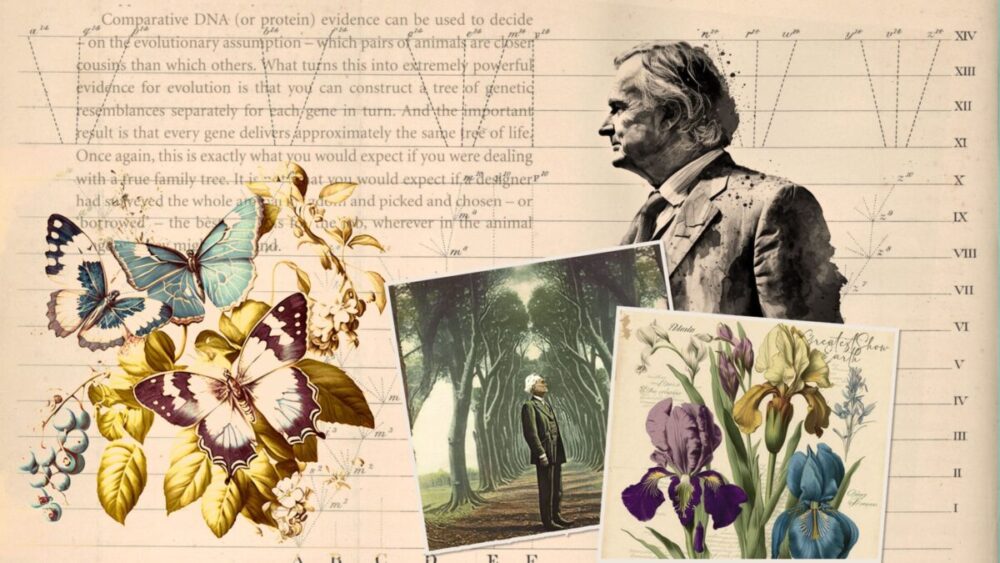
In 2009 atheist biologist Richard Dawkins offered a scientific test to decide between Darwinian evolution and intelligent design (ID). The results are in, and as guest Casey Luskin explains on this ID the Future, the evidence has broken strongly in favor of intelligent design. At the time Dawkins presented the test, he was confident that comparative DNA evidence supported Darwin’s tree of life and its idea of universal common ancestry. He made the point in his 2009 book The Greatest Show on Earth and in two interviews. As he put it, “The single most convincing fact or observation you could point to” in favor of Darwinian evolution over against ID “would be the pattern of resemblances that you see when Read More ›

maropeng museum cradle humankind
Maropeng Besucherzentrum im Craddle of Human Kind in Südafrika
Image Credit: Benjamin ['O°] Zweig - Adobe Stock

Casey Luskin Debunks One Museum’s Evolutionary Propaganda

On today’s ID the Future, geologist Casey Luskin continues to unpack his recently published essay against the view that humans evolved from ape-like ancestors via blind Darwinian processes. In this episode he shares his experience of walking into the fossil hall at South Africa’s famous Maropeng Museum and immediately being confronted by a piece of shameless materialist propaganda, a Richard Dawkins quotation prominently displayed as part of a floor-to-ceiling display. The quotation insisted that humans are essentially just DNA survival machines. Luskin says, not so fast, and points out the various ways such a view fails to explain important aspects of human behavior, including altruistic behavior toward non-kin. Luskin and host Eric Anderson also call evolutionary theory to task for being Read More ›

chimp
Close up portrait of a cute baby chimpanzee making eye contact
Image Credit: Patrick Rolands - Adobe Stock

Chimp and Human Genomes: An Evolution Myth Unravels

On today’s ID the Future, Casey Luskin rebuts the oft-repeated claim that the human and chimp genomes are 98-99% similar and therefore surely resulted from Darwinian common descent. Luskin cites an article in the journal Science which describes the 98-99% claim as a myth. The original figure was derived from a single protein-to-protein comparison, but once you compare the entire genomes, and use more rigorous methods, the similarity drops several percentage points, and on one account, down into the mid-80s. Additionally, the chimp genomes used in the original comparison studies borrowed the human genome for scaffolding, thus artificially boosting the degree of similarity. What about supposed junk DNA similarities between human and chimp? Why would an intelligent designer put the Read More ›

cradle of humankind
Lighted caves of Cradle of Humankind, a World Heritage Site in Gauteng Province, South Africa, the site of 2.8 million year old early hominid fossil and Mrs. Ples
Image Credit: spiritofamerica - Adobe Stock

New South Africa Book Explores Evidence of Design

Today’s ID the Future spotlights a new free online ID book from South Africa, Science and Faith in Dialogue, with contributions from Stephen Meyer, Hugh Ross, Guillermo Gonzalez, James Tour, Fazale Rana, Marcos Eberlin, and others. Geologist Casey Luskin joins host Eric Anderson to tell how the new peer-reviewed book came together and to describe the chapter he contributed, “Evolutionary Models of Palaeoanthropology, Genetics, and Psychology Fail to Account for Human Origins: A Review.” Luskin did his PhD in South Africa and had many opportunities to study various hominid fossils. Here he explains why he is convinced that intelligent design far better explains the fossil evidence than does Darwinian evolution.