ID the Future Intelligent Design, Evolution, and Science Podcast
Topic

information

air-filter-in-hand-background-light-stockpack-adobe-stock.jpg
air filter in hand background light
Image Credit: sergeylapin - Adobe Stock

Information, Specified Complexity and the Explanatory Filter

On this episode of ID the Future, we hear the third and final portion of a talk given at the 2020 Dallas Science and Faith conference. Daniel Reeves, education outreach coordinator at Discovery Institute, rounds out his extended explanation of intelligent design theory. Far from being “Gee whiz that’s complicated; it must be designed!,” the theory relies on well-defined concepts such as specified complexity and an explanatory filter that allows one to distinguish designed events from either chance, necessity, or a combination of the two. The key in the molecular biological realm: detecting functional information.
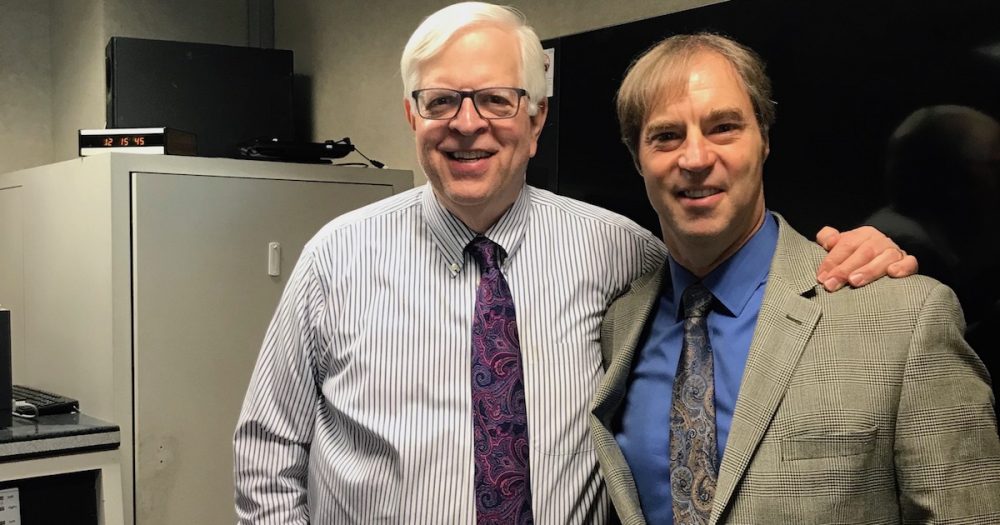
Meyer-and-Prager (2)

How Stephen Meyer Changed Dennis Prager’s Mind, Pt. 1

On this episode of ID the Future we hear part one of Dennis Prager’s remarkable Prager Show conversation with Dr. Stephen Meyer, director of Discovery Institute’s Center for Science and Culture. Prager had been agnostic on evolution, but reading and talking with Meyer changed his mind, he says. And it wasn’t any religious concerns, Prager explains. It was the science. Please consider donating to support the IDTF Podcast.

Electric-DNA-1024x538

DNA as Clue: How Intelligence Detects Information, and Creates It

On this episode of ID the Future, attorney and engineer Eric Anderson continues his discussion hosted by Mike Keas on what it means that there’s information in DNA, and how this distinguishes it from most other physical objects. He talks about what intelligence really is and does — and why we know it’s involved in creating the unique information in DNA. And he recommends an answer we can give to those who “dig their heels in” and disagree on what information is about. Please consider donating to support the IDTF Podcast.

toward-digital-fractal-realms-stockpack-adobe-stock.jpg
Toward Digital Fractal Realms
Image Credit: Yay Images - Adobe Stock

Why Information is the Basis of the Universe

On this episode of ID The Future, Sarah Chaffee talks with physicist Dr. Brian Miller about a recent article that argues that the fundamental basis of the universe is information. In this episode, Miller explains how physicists have come to rethink the role of information, moving from a materialist view in which information is seen as a byproduct of matter to a view in which information is seen as fundamental to the fabric of the cosmos.

IDTF-thumbnail
IDTF-thumbnail

Dr. David Snoke: Information and Entropy

On this episode of ID the Future, hear part 2 of a lecture given by David Snoke at a conference sponsored by the Christian Scientific Society. In this segment, Dr. Snoke, professor of physics and astronomy at the University of Pittsburg, discusses the relationship between information and entropy.

Read More ›
file cabinets and folders
File cabinet
Image Credit: beawolf - Adobe Stock

The Taxonomy of Information, Pt. 3

On this episode of ID the Future, Casey Luskin continues his discussion on the taxonomy of information. He explains how intelligent design employs the scientific method, uses principles of uniformitarianism, and enables scientific advances.

IDTF-thumbnail
IDTF-thumbnail

The Top 10 Problems with Darwinian Evolution, pt. 3

On this episode of ID the Future, Casey Luskin continues his series discussing the top 10 problems with biological and chemical evolution. This series is based upon Casey Luskin’s chapter in the volume More than Myth, edited by Paul Brown and Robert Stackpole (Chartwell Press, 2014). In this segment, Casey discusses the third problem: that random mutations cannot generate the genetic information required for irreducibly complex structures.

Read More ›
IDTF-thumbnail
IDTF-thumbnail

The Evidence for Intelligent Design in Nature

Where do we find evidence of design in Nature? This episode of ID the Future features Casey Luskin at a recent lecture, explaining how information in DNA, molecular machines, and cosmic fine tuning all point to intelligent design.