
Jonathan Wells Dives into “the Genome’s Uncharted Territories”
On this ID the Future, Icons of Evolution author Jonathan Wells sat down with host and fellow biologist Ray Bohlin at the August 2021 Insiders’ Briefing near Seattle to discuss some fresh discoveries into the workings of the human genome detailed in a recent article in the journal Axios, “Diving into the Genome’s Uncharted Territories.” As the article details, researchers continue to discover important functions in the noncoding regions of the human genome, once regarded by evolutionists as junk DNA. Wells and Bohlin explore the exciting new findings and some of their implications for modern evolutionary theory and intelligent design.

Information, Specified Complexity and the Explanatory Filter
On this episode of ID the Future, we hear the third and final portion of a talk given at the 2020 Dallas Science and Faith conference. Daniel Reeves, education outreach coordinator at Discovery Institute, rounds out his extended explanation of intelligent design theory. Far from being “Gee whiz that’s complicated; it must be designed!,” the theory relies on well-defined concepts such as specified complexity and an explanatory filter that allows one to distinguish designed events from either chance, necessity, or a combination of the two. The key in the molecular biological realm: detecting functional information.

A Billion Genes and Not One Beneficial Mutation
Evolutionists often speak in generalities about beneficial mutations. Such mutations may be rare, we’re assured, but they happen, and when they do, natural selection is there to capture, preserve and pass them along. All right, we now have some data to consider. We can put a number to the frequency of beneficial mutations in a very large sample. The number is …
Read More ›
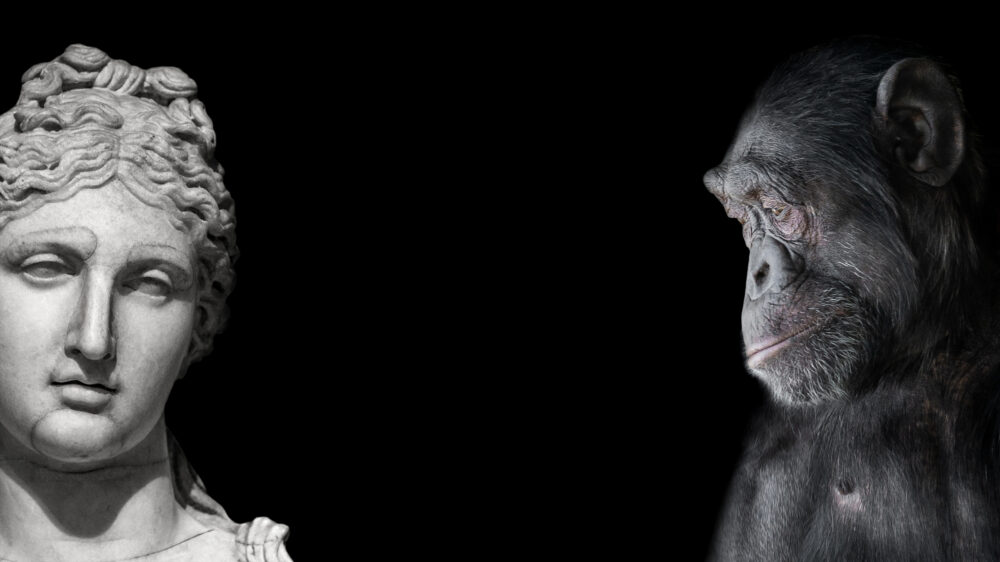
How Chimps and Humans are Different, Pt. 1: The Genome
Ann Gauger discusses the common claim that humans and chimpanzees share 99% of their DNA. This figure is outdated and that scientists now acknowledge the similarity is less than previously reported. Newer research points to greater differences. Key Topics Gauger challenges the widely reported 99% similarity between human and chimpanzee genomes, explaining that more comprehensive analyses reveal greater genetic differences. Dr. Gauger provides clear explanations of genetic terminology and sequencing methods to help listeners understand the complexities behind genome comparisons. Summary of episode via Perplexity.ai.
On Human Origins: Is Our Genome Full of Junk DNA? Pt 2.
On this episode of ID the Future, biologist Richard Sternberg continues his presentation evidence that refutes the myth that the human genome is full of junk DNA. This is the second in a series from a recent Science and Human Origins conference featuring Dr. Sternberg, John West, Ann Gauger and Casey Luskin.
Read More ›