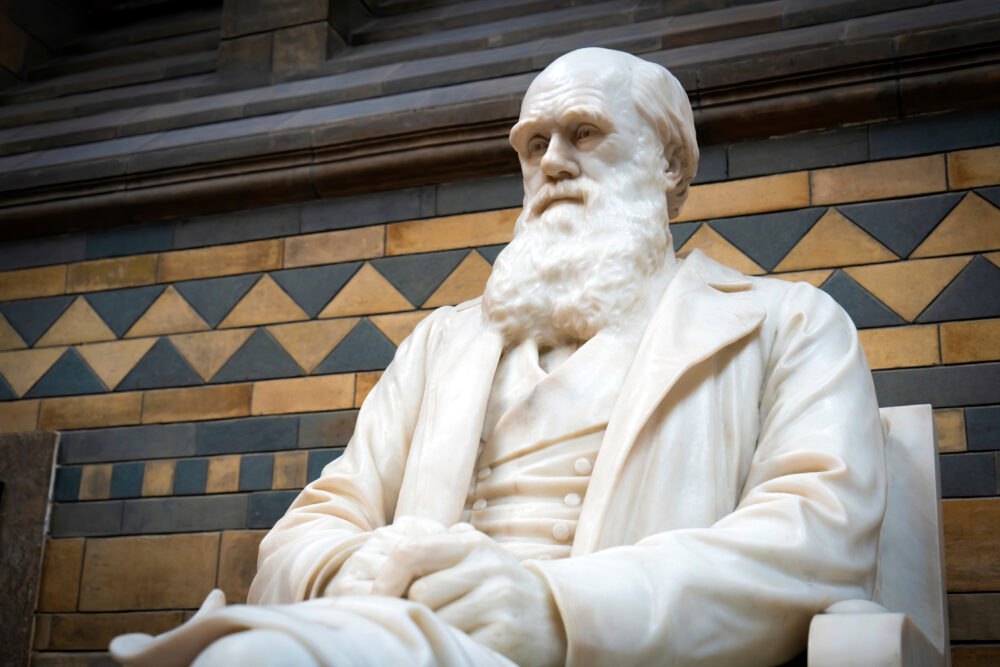
London, England - December 4, 2019: Statue of Charles Robert Darwin was an English naturalist and biologist in Natural History Museum. London, United Kingdom.
In this ID The Future, host Casey Luskin concludes a two-part conversation with University of Warwick professor and author Steve Fuller reflecting on the 20th anniversary of the Kitzmiller v. Dover trial, a case that examined the constitutionality of teaching intelligent design in public schools. Fuller discusses his experience serving as an expert witness for the defense. He defends his support of a policy that merely informed students of alternative theories to Darwinian evolution. He explains why high school is an ideal time to encourage an open mind toward science. Then he pivots to discuss the deeper issue of institutional censorship in science and how establishment science functions as a religion. He characterizes intelligent design as "anti-establishment" and suggests there's hope for a more pluralistic approach to science in the near future. This is Part 2 of a two-part interview. Read More ›
On this episode of ID the Future, host Casey Luskin begins a two-part conversation with University of Warwick professor Steve Fuller to reflect on the historical and philosophical foundations of intelligent design (ID) and the 20th anniversary of the Kitzmiller v. Dover trial. Fuller, an expert witness in the Dover trial and a scholar in the history and philosophy of science, challenges the popular "conflict thesis" that suggests that science and religion are perpetually at war. Instead, he describes a different historical understanding where modern science originated from a theological foundation, noting pioneers like Newton and Galileo, who viewed the universe as an intelligible machine designed by a divine mind. This tradition suggests that the very project of science was launched by the belief that human minds, created in the image and likeness of God, are capable of uncovering the logical laws governing reality.
The conversation delves into why intelligent design should be viewed as a rich, interdisciplinary research tradition rather than a modern invention. Fuller explores the concept of biomimicry as a form of reverse engineering nature to uncover the hidden engineering elements within organisms. While Luskin notes that ID can be approached through purely scientific observations of intelligent agency, Fuller argues that theology remains a vital component because it explains why the designer uses "code" or the "logos"—be it in DNA or mathematical laws—as a creative medium.
This insightful first part of a two-part series highlights how ID integrates biology, engineering, and information science to offer a comprehensive explanation for the complexity of the natural world. Read More ›
Was the modern intelligent design (ID) movement "over after Dover," as many ID critics hoped it would be? Quite the opposite. In the last two decades ID has flourished as a scientific research program and continues to gain momentum in both academia and the public square. On today's ID The Future, host Andrew McDiarmid concludes his conversation with geologist, legal scholar, and Dover trial expert Dr. Casey Luskin. In this segment, marking the 20th anniversary of the Kitzmiller vs. Dover trial of 2005, the pair examine the outcome of the Dover trial, in which a judge ruled that intelligent design was a religious viewpoint, not science, and therefore unconstitutional to teach in public schools. Luskin explains why the Dover ruling was highly flawed and unreliable and how it misrepresented the definition of science and the arguments of ID proponents. Luskin also reveals how the ID movement has flourished in the twenty years since Dover. This is Part 2 of a two-part conversation. Read More ›
Over After Dover. That was the hopeful mantra of many critics of intelligent design (ID) after the Kitzmiller vs. Dover trial in 2005. They were hoping a federal judge could issue a decree from on high that would stop the ID movement cold in its tracks and neo-Darwinism could go back to being unquestioned, unchallenged orthodoxy. But was it over after Dover? Not even close. On this ID The Future, host Andrew McDiarmid marks the 20th anniversary of the Dover trial by beginning a two-part conversation with geologist, legal scholar, and Dover trial expert Dr. Casey Luskin. Luskin takes us back to 2005 to give us his unique perspective on the events that led to the Dover trial, his own personal experiences of the case, and the position the Discovery Institute's Center for Science & Culture held on the issues at stake. This is Part 1 of a two-part conversation. Read More ›