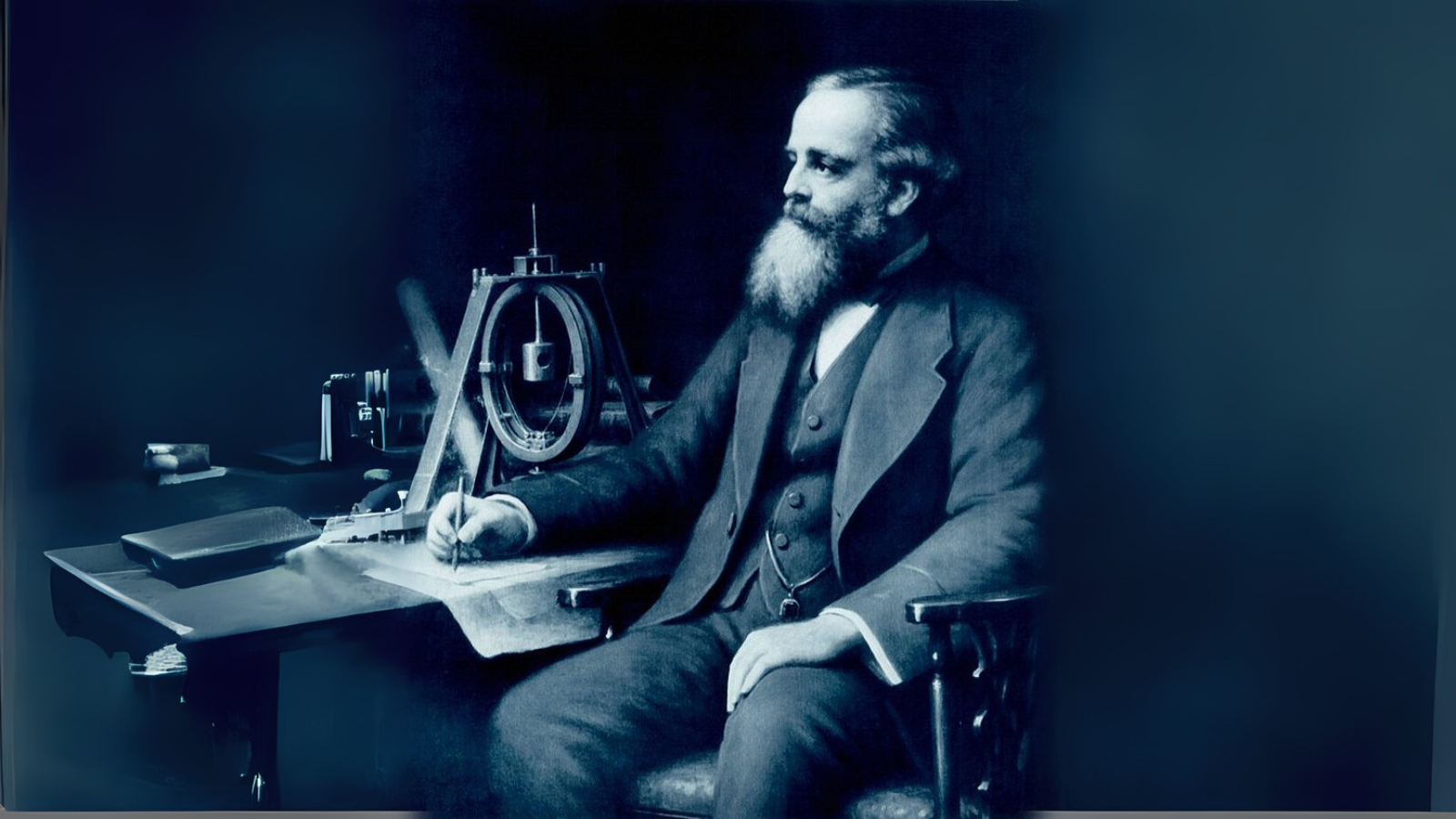
Faith and Reason: A Profile of Mathematician James Clerk Maxwell
He’s one of the most significant scientists of the nineteenth century, and his work laid the foundation for modern physics, quantum mechanics, and relativity. Scottish physicist and mathematician James Clerk Maxwell is a pivotal figure in the history of modern science, and his scientific study was inspired by the belief that the works of nature reflect the work of a designing intelligence. Today, my guest is mathematics educator, curriculum designer, and medical physicist Amos Tarfa, who helps us profile Maxwell to better understand the great scientist’s contributions and lasting influence.
Maxwell is considered by some to be the greatest scientist between Isaac Newton and Albert Einstein. As if to confirm this, when asked if he stood on the shoulders of Newton, Einstein replied, “No, on the shoulders of Maxwell.” So why is he so important? Before Maxwell, electricity, magnetism, and light were studied as separate phenomena. He unified and extended the laws that govern those phenomena into a single framework, known as Maxwell’s Equations. His four elegant equations showed they are all aspects of a single electromagnetic field. This was one of the great unifications in physics, comparable to Newton uniting celestial and terrestrial mechanics. In addition, Maxwell’s field theory introduced a new way of thinking about nature—not just particles and forces acting at a distance, but fields filling space. This directly influenced Einstein, who built on Maxwell’s work to develop special relativity. Tarfa reviews these achievements and places them in the appropriate historical context.
Maxwell also had a strong belief that nature showed evidence of intelligent design and is considered a model of the God-believing intellectual. Tarfa discusses how Maxwell harmonized his faith and reason, and gives examples of how his discoveries point toward deeper questions about order, design, and meaning in the universe.
This is Part 1 of a two-part conversation.
Dig Deeper
- Learn more about Amos Tarfa’s work at www.amosthemathguy.com.
- More on mathematics and intelligent design: