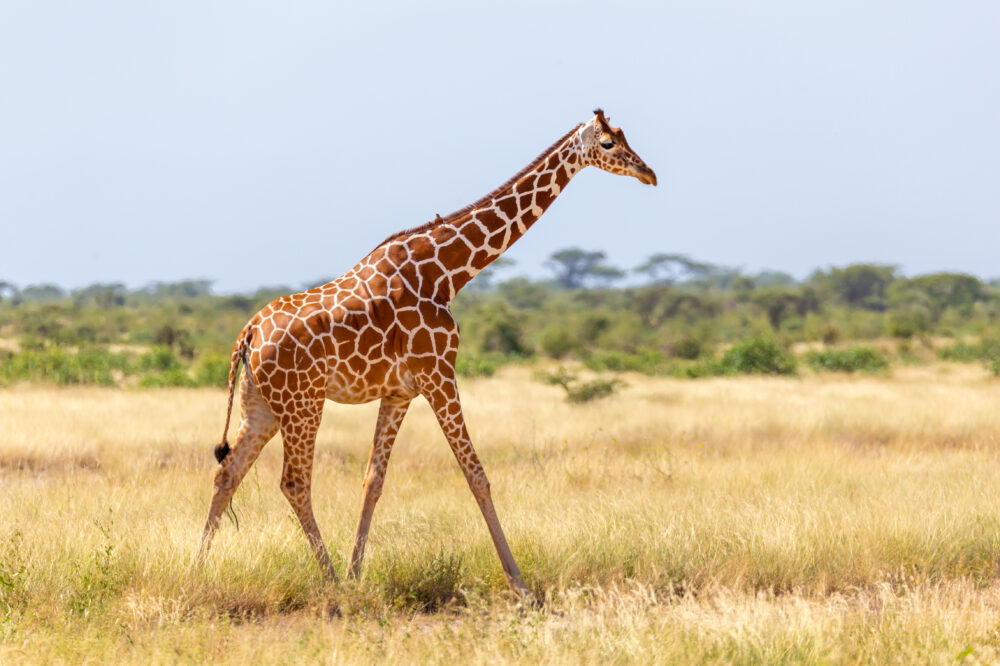
How did the giraffe get its long neck? It sounds like the beginning of a children’s bedtime story, and it certainly has been that. But it’s also a matter of serious scientific debate, and the debate continues today. On this installment of ID The Future, host Andrew McDiarmid concludes his two-part discussion correcting claims of giraffe evolution with retired geneticist Dr. Wolf-Ekkehard Lönnig.
In Part 2, Dr. Lönnig challenges the prevailing narrative that the fossil Samotherium major serves as a transitional "missing link" in giraffe evolution. Lönnig argues that this evolutionary interpretation is contradicted by the facts. Instead, he identifies Samotherium as a "mosaic form," an organism possessing a combination of fully developed and basic traits that do not unequivocally connect it to the modern long-necked giraffe.
This is Part 2 of a two-part conversation. Read More ›
We’ve all admired the long, majestic neck of the giraffe, and the question remains: how did the giraffe get its long neck? Is it a product of an evolutionary process? Or was a process of foresight and purpose involved? Helping us unpack this today is retired geneticist Dr. Wolf-Ekkehard Lönnig, who challenges the traditional narrative of giraffe evolution, noting a sharp disconnect between Darwinian predictions and the actual fossil record. While neo-Darwinism, by default, expects a gradual, step-by-step progression of slight variations leading to the modern giraffe, the geological evidence tells a different story. Learn how the twin problems of stasis in the fossil record and silos in the development of giraffes pose major problems for the standard just-so story of giraffes. Read More ›
Is the famous “panda’s thumb” evidence of unguided evolutionary processes, or is it a masterpiece of engineering and the result of intelligent design? On this ID The Future, host Andrew McDiarmid concludes his conversation with retired geneticist, Dr. Wolf-Eckehard Lönnig, an intelligent design pioneer who has been offering robust criticism of Darwinian theory and advocating for intelligent design for over 50 years. The topic is Dr. Lönnig's new paper reviewing the debate over the panda’s thumb. Giant pandas have an extra digit, an elongated wrist bone, that aids the animal in walking and manipulating bamboo with great dexterity. Some claim it's a clumsy structure produced by evolutionary processes. It wouldn't win any design awards, but it gets the job done. Others call it one of the most extraordinary manipulation systems in the mammalian world and clear evidence of purposeful engineering. So which is it? Dr. Lönnig helps us answer that question. This is Part 2 of a two-part conversation. Read More ›