ID the Future Intelligent Design, Evolution, and Science Podcast
Topic

Intelligent Design

Meyer and Metaxas: Stephen Meyer’s Journey into Intelligent Design

On this episode of ID the Future, author and radio host Eric Metaxas interviews Stephen Meyer at the 2019 Dallas Conference on Science and Faith. Meyer, author of the New York Times bestseller Darwin’s Doubt and director of the Center for Science and Culture, tells how he started out asking the “why” questions — some of the same ones Isaac Newton had wondered about — questions that remain with us today. A few years later, in the 1980s, he happened onto a science/faith conference (also in Dallas), and that started him on his journey of studying, writing, and teaching on intelligent design. Please consider donating to support the IDTF Podcast.
Kepler, Galileo, the Book of Nature, and the First Mathematician

On this episode of ID the Future, Andrew McDiarmid talks with science historian Michael Keas on pioneering mathematical astronomer Johannes Kepler, based on Keas’ new work from ISI Books, Unbelievable: 7 Myths About the History and Future of Science and Religion. Kepler studied theology before turning to math and science, and it was his belief in God that guided his extraordinary discoveries. “Without an architect who created the world,” he said, “there is no … power in mathematics to make anything material.” Scientists, in his view of God, were thinking the thoughts or ideas that God himself had thought any time they discovered some law or deep pattern in nature. Kepler is just one of a long list of great early scientists, including Galileo, who saw a “book” of God’s revelation in nature written in the language of mathematics. God designed the world for discovery, Kepler believed, and that conviction inspired his groundbreaking investigations.

Read More ›

Aristotle, Behe and Cells: The ABCs of Evolution’s Inadequacies

On this episode of ID the Future, biochemist Michael Behe talks with Andrew McDiarmid about Behe’s new book, Darwin Devolves: The New Science About DNA That Challenges Evolution. Behe shares about his thinking on evolution as a post-doc, talks about the history of biology, and discusses why the turn of the millennium has been the perfect time to gain knowledge about the foundation of evolution and life’s history.

Read More ›
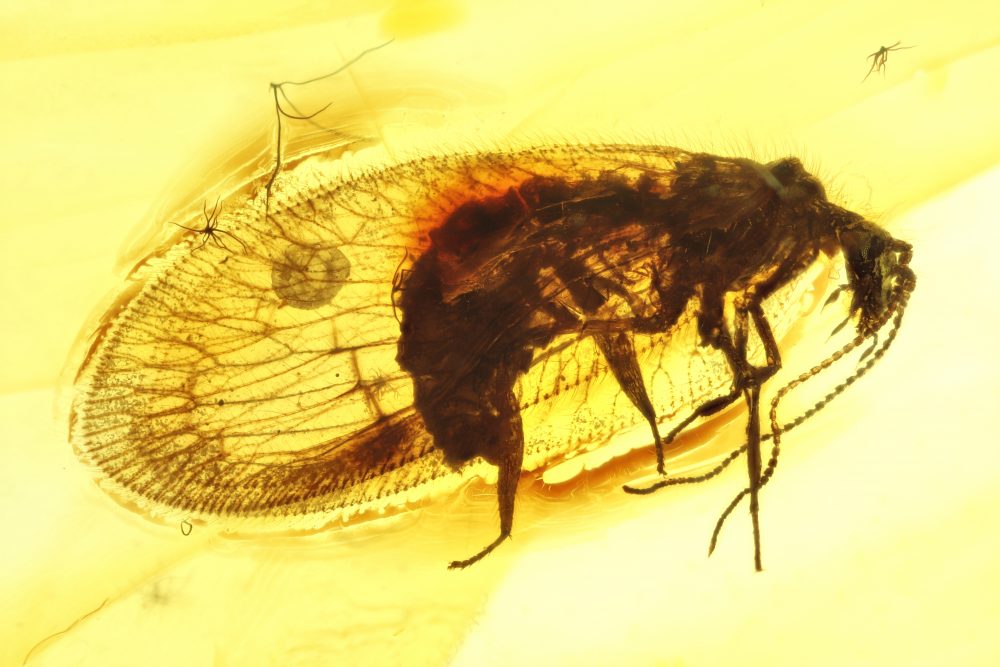
brown lacewing amber.jpg
brown lacewing imprisoned in baltic amber
Image Credit: Björn Wylezich - Adobe Stock

Günter Bechly: Rich Fossil Record Says No to Insect Evolution

On this episode of ID the Future, Dr. Günter Bechly, paleoentomologist and former curator for amber and fossil insects for the State Museum of Natural History in Stuttgart, Germany, talks with host Andrew McDiarmid about evidence for macroevolution among insects. The fossil record is “saturated,” Bechly says. By that he doesn’t mean there aren’t new fossil forms to discover. Bechly himself has discovered several. He means we have an extensive enough sampling to confidently discern the major patterns of change and stasis in the history of life. And it shows no sign of insect evolution. It shows no transition from marine arthropods to terrestrial insects, none from wingless insects to winged insects, and no gradual evolution to insects (such as Read More ›

NonsenseAverick

Averick Takes on the “God of the Gaps” Objection

On this episode of ID the Future, Rabbi Moshe Averick, author of Nonsense of a High Order: The Confused World of Modern Atheism, responds to the objection that intelligent design is a feeble “God of the Gaps” approach, an argument from ignorance. Provocative and entertaining, Averick describes the attack as “less than feeble.” He says it isn’t because of what we don’t know, but because of what we do know. He offers as an illustration the widespread skepticism in the physics community toward the possibility of anyone ever building a perpetual motion machine. Their skepticism is not driven by ignorance of how to build such a machine, Averick notes. It’s driven by their knowledge of the fundamental laws of physics. Read More ›

Behe Responds to the Journal Science, Pt. 2: Darwin Devolves on Trial

On this episode of ID the Future, Andrew McDiarmid continues his conversation with biochemist Michael Behe, author of the newly released Darwin Devolves: The New Science About DNA That Challenges Evolution. Here Behe further presses the case that the review bypasses his book’s main point and that the reviewers appear to have misunderstood the plain language of one of his arguments in a previous book. Also, the reviewers claim that Behe hasn’t answered his critics’ objections on key points, a charge Behe shows is demonstrably false. Despite the negative review, Behe says he remains optimistic. Listen in to learn why. Please consider donating to support the IDTF Podcast.

The Journal Science Reviews Darwin Devolves. Behe Responds.

On this episode of ID the Future, Andrew McDiarmid interviews biochemist Michael Behe, author of the forthcoming Darwin Devolves: The New Science About DNA That Challenges Evolution (order here) to get his response to a review of the book that appeared in the prestigious journal Science. Behe says the review largely ignores the central point of his book; the reviewers fail to distinguish between claims that evolution built something, and explanations for how it could have built it; and they miss something crucial about lab experiments that engineer examples of evolution. Please consider donating to support the IDTF Podcast.

Australian Zebra Finch.jpg
Australian Zebra Finch flock of five, perched on a branch. Clean blue background
Image Credit: natian - Adobe Stock

Michael Behe’s Darwin Devolves: Evolution Works, But Nothing Like What They Claim For It

On this episode of ID the Future, Jay Richards interviews biologist and Center for Science and Culture senior fellow Michael Behe on his forthcoming book Darwin Devolves: The New Science About DNA That Challenges Evolution, available now for pre-order. Very recent advances in gene sequencing show that genetic mutations and natural selection sometimes work to create niche advantages, but by breaking genes, not by building new ones. It’s like increasing fuel efficiency by jettisoning things from your car: great if fuel efficiency is a matter of life or death, not so great if you actually wanted that back seat in there. And in any case, it isn’t how a car gets built in the first place. In the same way, Darwinian evolution can Read More ›

Rob Crowther Debriefs Jay Richards on the Dallas Conference on Science & Faith

On this episode of ID the Future, host Robert Crowther speaks with Discovery Institute Senior Fellow Jay Richards, a speaker at last weekend’s Dallas Conference on Science & Faith. Coming available soon on video, this conference featured Richards, Eric Metaxas, Stephen Meyer, and world-renowned synthetic organic chemist James Tour — plus a surprise guest. For all the great presenters there, though, Richards’ favorite feature of the conference was the thousand attendees — some of them skeptics — who stayed straight through to the close and beyond, asking questions and learning that science, more than ever, supports faith in a designing intelligence.

Stephen Meyer Teases the Dallas Conference on Science and Faith

On this episode of ID the Future, Kirby Anderson, host of the nationally syndicated Point of View radio show, interviews New York Times bestselling author Stephen Meyer about the Dallas Conference on Science and Faith. Read More ›