ID the Future Intelligent Design, Evolution, and Science Podcast
Topic

Materialism

DCOSAF-2019-001-Meyer-Metaxas copy

Eric Metaxas on the Miracle of a Fine-Tuned Universe, Pt. 1

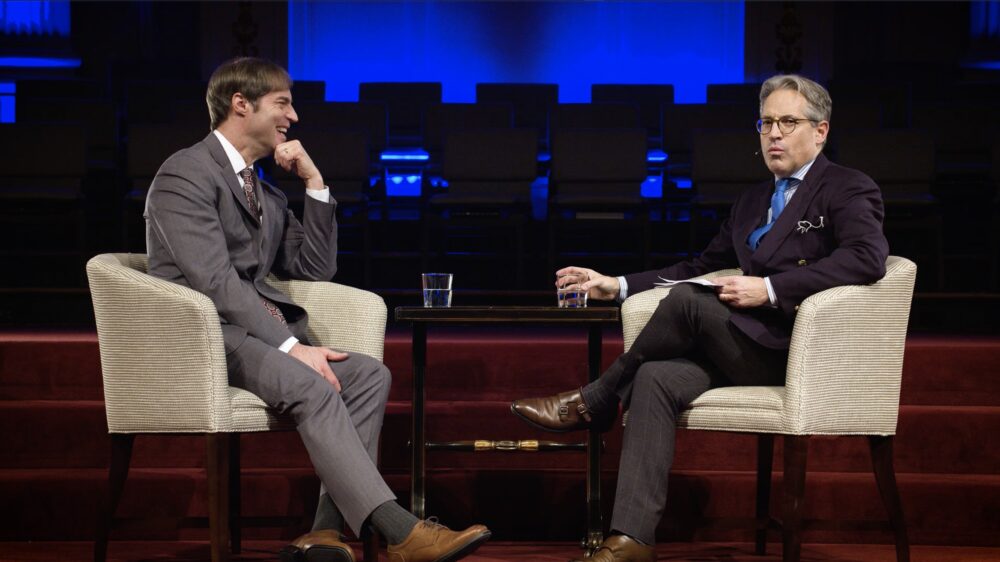
Today’s episode of ID the Future features Part 1 of a talk bestselling author Eric Metaxas gave at the 2019 Dallas Conference on Science and Faith in Dallas. His topic was the miracle of our fine-tuned universe, taken in part from his book Miracles: What They Are, Why They Happen, and How They Can Change Your Life. Metaxas also discusses another thing he finds amazing: that so many people think the progress of science means the retreat of religion.

Storey's Way and the main entrance of Churchill College, Cambridge in June 2019.
Photo by Cmglee via Wikimedia Commons

First the Royal Society Meeting, Now Cambridge’s “Evolution Evolves”: Paul Nelson Reports

On this episode of ID the Future, intelligent design proponent and philosopher of biology Paul Nelson reports on a recent conference he attended at the University of Cambridge, “Evolution Evolving: An International Conference on the Evolving Mechanisms and Theoretical Framework of Evolutionary Biology.” Scientists from around the globe gathered under the operating assumption that the modern evolutionary synthesis is sorely lacking. As with many of the biologists who attended the 2016 Royal Society meeting “New Trends in Evolutionary Biology,” many of the attendees of the Cambridge event find themselves disenchanted with Neo-Darwinism and weighing their options. They’re still not looking outside the walls of the “City of Naturalism,” Nelson says, but it’s fascinating and encouraging to witness the increased openness Read More ›

ai head.jpg
AI head, robotic artificial intelligence machine face. Glowing lights, yellow LEDs. Front view. 3d render
Image Credit: vrx123 - Adobe Stock

Wesley J. Smith on the Transhumanist Wasteland

On this episode of ID the Future, Emily Kurlinski interviews bioethicist, author, and Discovery Institute Senior Fellow Wesley J. Smith on transhumanism. It’s a technology-driven anti-aging effort to create a post-human species with advanced intelligence, brain-computer interfaces, and even immortality. Built on zeal and desperation to defeat death, it’s a quasi religion, except with no plan or apparent interest in cultivating a more wise and loving human species — which, Smith argues, makes it more dangerous than it might at first appear.

Stephen Meyer: God and the Origin of the Universe, Pt. 2

This episode of ID the Future features the second and concluding part of a talk given by Stephen Meyer at the 2019 Dallas Science and Faith Conference. Picking up from his previous comments on how atheistic/materialistic assumptions have come to dominate much of the science community. Read More ›

Stephen Meyer: God and the Origin of the Universe, Pt. 1

This episode of ID the Future features part one of a talk given by Stephen Meyer at the 2019 Dallas Science and Faith Conference. In this portion of the talk, Meyer explains Christianity’s crucial influence on the founders of science, and how much of the scientific establishment has shifted toward methodological atheism. Read More ›
NonsenseAverick

Averick Takes on the “God of the Gaps” Objection

On this episode of ID the Future, Rabbi Moshe Averick, author of Nonsense of a High Order: The Confused World of Modern Atheism, responds to the objection that intelligent design is a feeble “God of the Gaps” approach, an argument from ignorance. Provocative and entertaining, Averick describes the attack as “less than feeble.” He says it isn’t because of what we don’t know, but because of what we do know. He offers as an illustration the widespread skepticism in the physics community toward the possibility of anyone ever building a perpetual motion machine. Their skepticism is not driven by ignorance of how to build such a machine, Averick notes. It’s driven by their knowledge of the fundamental laws of physics. Read More ›

Unbelievable: ET and the Futuristic Myth of a Material God

On this episode of ID the Future, Andrew McDiarmid continues his conversation with science historian Michael Keas on myths of science and religion, based on Keas’ new work from ISI Books, Unbelievable: 7 Myths About the History and Future of Science and Religion. This time the myth comes not from the past but the future. That is, it’s the supposedly scientific belief that ET is coming, and when it comes, it will look just like a god to us. It will replace earthly religion with an advanced, more ethical alternative, and we’ll finally achieve enlightenment. It’s just as much a myth as any other, yet it’s shaping people’s worldviews anyway. Please consider donating to support the IDTF Podcast.

stained-glass-ceiling-of-palace-of-catalan-music-stockpack-adobe-stock.jpg
Stained glass ceiling of Palace of Catalan Music
Image Credit: zdebskiy - Adobe Stock

Why Scientific Materialism is No Match for Truth, Beauty, and Goodness

On this episode of ID the Future, David Klinghoffer speaks with Dr. Ann Gauger, biologist and Director of Science Communication for Discovery Institute’s Center for Science and Culture, about her recent article “The Transcendental Treasury of Truth, Beauty, and Goodness” at EvolutionNews.org. These abstract concepts don’t derive from the material world, yet we feel impoverished without them; they’re foundations of a life worth living. Materialistic evolutionary explanations for truth, beauty, and goodness fall flat. Some of them even reduce them to mere illusion. It takes a designer who knows truth, beauty, and goodness to explain what we all know: They’re really real.

Stephen Meyer Teases the Dallas Conference on Science and Faith

On this episode of ID the Future, Kirby Anderson, host of the nationally syndicated Point of View radio show, interviews New York Times bestselling author Stephen Meyer about the Dallas Conference on Science and Faith. Read More ›
charlesdarwin2

Pearcey on Darwin and Huxley: Philosophy, Not Evidence, Drove Them to Their Conclusions

On this episode of ID the Future, Nancy Pearcey returns to explain what historians know, but few of the rest of us do: If anything, Charles Darwin’s science grew out of his naturalistic philosophy, not the other way around. One historian said Darwin’s naturalism came first, and “only later did he find a theory to validate his convictions.” His “bulldog”, T.H. Huxley, liked Darwinism more for its philosophy than its science. And even Darwin admitted the evidence wasn’t all it could or should be. Please consider donating to support the IDTF Podcast.