

ID the Future Intelligent Design, Evolution, and Science Podcast
Topic

truth

young-male-sitting-under-tree-with-book-looking-around-havin-188575155-stockpack-adobestock
Young male sitting under tree with book looking around, having pleasant thoughts
Image Credit: motortion - Adobe Stock

Mind Over Matter: Darwin, AI, and the Future of Reason

If our minds are the product of a blind and aimless process, what reason do we have to believe what we think? But if we can be rational because a rational intelligence designed life and the universe, how does that change how we should think about thinking? On this ID The Future, host Andrew McDiarmid concludes his conversation with science teacher and writer Rebekah Valerius about an essay she recently wrote unpacking the argument from reason and its implications for Darwinism, materialism, and atheism. In Part 2, Valerius shows why a Darwinian process cannot be responsible for our powers of reason. She also offers the argument from reason as a lens to better understand modern technology like artificial intelligence. This is Part 2 of a two-part conversation. Read More ›
compass-in-hand-with-sunset-sky-on-the-background-stockpack-257536800-stockpack-adobestock
compass in hand with sunset sky on the background
Image Credit: Pyroll - Adobe Stock

Testing the Truth: Nancy Pearcey on Worldview and Reality

On today's episode of ID The Future, we’re sharing a conversation with author, speaker, and professor Nancy Pearcey that originally aired on the eX-skeptic Podcast. Before Pearcey became one of the leading Christian voices engaging questions about worldview, intelligent design, evolution, and scientific materialism, she walked away from Christianity altogether. In this candid interview, Pearcey reflects on her journey through atheism, relativism, and Eastern spirituality before ultimately rediscovering Christianity as a worldview capable of explaining both reality and human dignity. Read More ›
crumpled-paper-balls-and-light-bulb-stockpack-adobe-stock-1913121005-stockpack-adobestock
Crumpled paper balls and light bulb.
Image Credit: andranik123 - Adobe Stock

How to Restore Sanity to Scientific Debates
Everywhere you turn, you’re likely to see evidence of error in thinking, and the realm of science is no exception. On this ID The Future, host Andrew McDiarmid concludes his conversation with J. Budziszewski, a professor of government, philosophy, and civic leadership at the University of Texas at Austin and author of the new book Pandemic of Lunacy: How to Think Clearly When Everyone Around You Seems Crazy. In his book, Budziszewski identifies thirty irrational ideas that are prevalent in modern society. He argues that many people have abandoned common sense and objectivity, leading to a cloud of confusion regarding human nature, science, and morality. In Part 2, we jump into more lunacies relevant to the scientific debates around human beings, biological life, and design in nature. Read More ›
Screenshot-2026-04-01-at-10924PM
Image of book cover of Truth, by Michael Shermer.

Egnor vs. Shermer: God, Science, and the Search for Truth
ID The Future listeners now get to enjoy two episode a month from our sister podcast Mind Matters News, a production of the Discovery Institute’s Walter Bradley Center for Natural and Artificial Intelligence. The Mind Matters News podcast features interviews from experts in computing, engineering, science, and philosophy who bring sanity to the conversation about natural and artificial intelligence. And although the Mind Matters News podcast will not often explicitly discuss intelligent design, it regularly explores the nature of intelligence, the origin of information, and the things that make us uniquely human, concepts that are central to the theory of intelligent design. On this episode of Mind Matters News, host and neurosurgeon Dr. Michael Egnor welcomes Michael Shermer, historian of science and founder of Skeptic magazine, to discuss Shermer's new book Truth: What It Is, How to Find It, and Why It Still Matters. The conversation quickly evolves into a deep philosophical debate between Egnor and Shermer over whether truths about morality and the universe are created by humans or discovered as objective features of reality. Read More ›
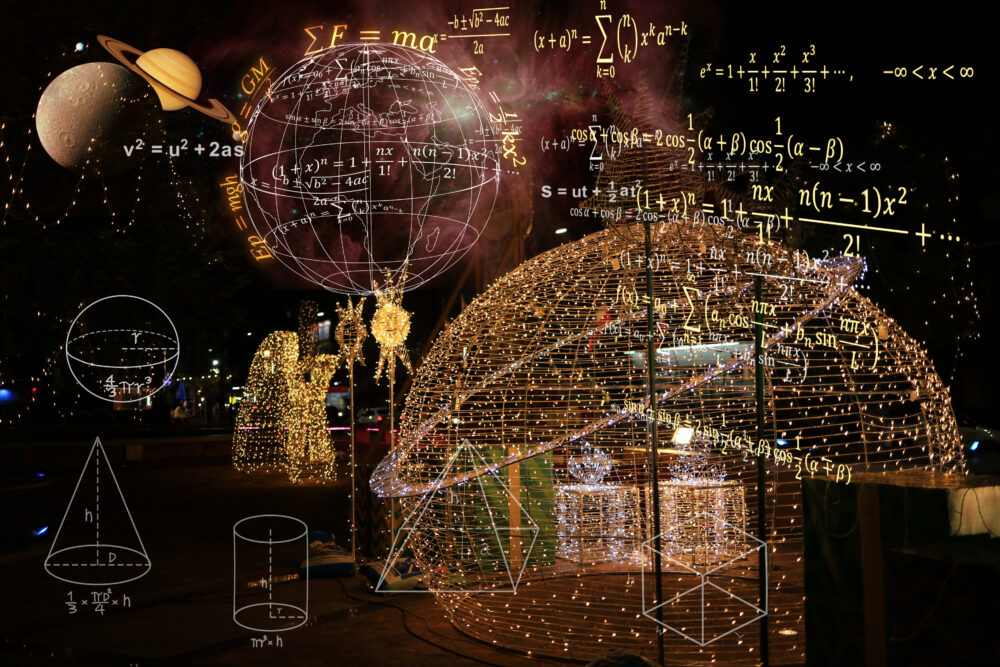
Physics or mathematical equations on a universe decorative LED background give the impression of interstellar space travel.
Image Credit: AREE - Adobe Stock

Finding Beauty and Harmony in the Sciences
Materialist philosopher Bertrand Russell once wrote that "only on the firm foundation of unyielding despair, can the soul’s habitation…be safely built.” But is this worldview of scientific materialism in line with what science has revealed to us in the last century? On this episode of ID The Future, we’re pleased to share a recent conversation between Dr. Melissa Cain Travis and author and teacher Dr. Ken Boa on the Explorers Podcast. The topic is beauty, harmony, and truth in the sciences. We are grateful to the producers of the Explorers Podcast for permission to re-broadcast this conversation. Read More ›
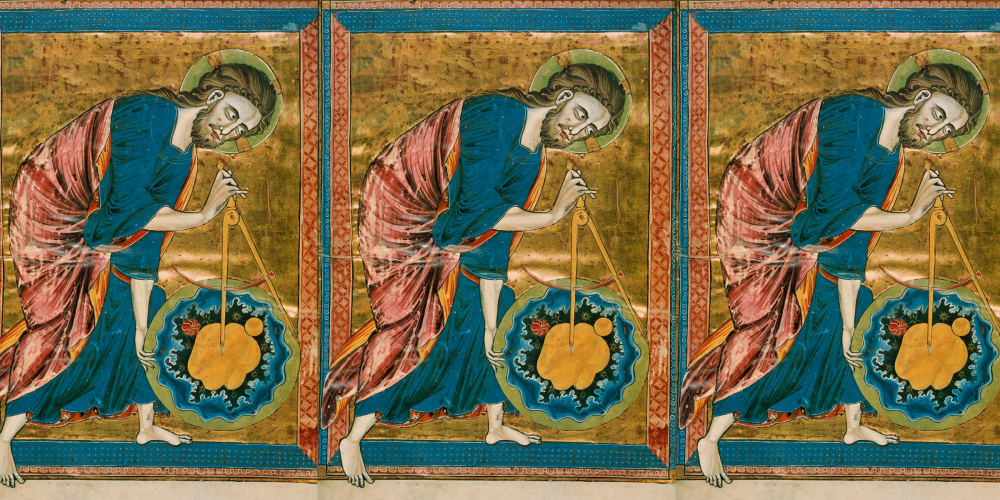
God the Geometer
God the Geometer — Gothic frontispiece of the Bible moralisée, representing God's act of Creation. France, mid-13th century

William Dembski on Scientism, Science, and Christian Faith

On today’s ID the Future, philosopher William Dembski and host Casey Luskin explore the relationship between science and faith. What is science? What is faith? How does Christianity define faith? Dembski explains that faith in the Judeo-Christian tradition is not the opposite of reason; at the same time, faith possesses a relational component—trust in a just, gracious, and reasonable God—that goes beyond mere assent to propositions. As for science, Dembski describes it as a careful search for truths about the natural world, including truths about key elements such as the birth of our fine-tuned universe and the origin of living things. Dembski says that he is convinced that scientific discoveries, unshackled from atheistic blinders, point strongly to intelligent design as Read More ›

stained-glass-ceiling-of-palace-of-catalan-music-stockpack-adobe-stock.jpg
Stained glass ceiling of Palace of Catalan Music
Image Credit: zdebskiy - Adobe Stock

Why Scientific Materialism is No Match for Truth, Beauty, and Goodness

On this episode of ID the Future, David Klinghoffer speaks with Dr. Ann Gauger, biologist and Director of Science Communication for Discovery Institute’s Center for Science and Culture, about her recent article “The Transcendental Treasury of Truth, Beauty, and Goodness” at EvolutionNews.org. These abstract concepts don’t derive from the material world, yet we feel impoverished without them; they’re foundations of a life worth living. Materialistic evolutionary explanations for truth, beauty, and goodness fall flat. Some of them even reduce them to mere illusion. It takes a designer who knows truth, beauty, and goodness to explain what we all know: They’re really real.