

ID the Future Intelligent Design, Evolution, and Science Podcast
Topic

Natural Selection

darwins-finches-stockpack-adobe-stock-543249874-stockpack-adobe_stock
Darwin's finches
Image Credit: William Huang - Adobe Stock

Jonathan Wells Puts Natural Selection In Its Place

Dr. Jonathan Wells was a true giant of the intelligent design research community. As we mourn his recent passing, we also celebrate anew his considerable contributions to the arguments for intelligent design and the debate over evolution. On this episode of ID The Future out of the vault, Dr. Wells continues a conversation with Tom Woodward on The Universe Next Door. Dr. Wells explains more of the icons of evolution he details in his popular book and why much of what we hear about evolution is wrong. Listen in as they discuss Darwin's finches, four-winged fruit flies, humans with tails, and more. This is Part 2 of a two-part conversation. Read More ›
water-pouring-on-hand-in-morning-ligth-background-stockpack-310407095-stockpack-adobe_stock
Water pouring on hand in morning ligth background
Image Credit: lovelyday12 - Adobe Stock

Sunlight And Water: Uniquely Fit to Sustain Life

f the sun didn't power the photosynthesis of green plants, we wouldn't be breathing right now. And without the finely tuned properties of water, Earth would be a frozen, lifeless wasteland. Coincidence? Or is something else at work? On this episode of ID The Future, host Andrew McDiarmid continues his ongoing series with Dr. Jonathan McLatchie unpacking the many features of our planet and the cosmos that allow for advanced life like ours to exist. Here, the discussion turns to the life-friendly properties of sunlight and water. Read More ›
below-photo-of-poplar-trees-and-recycle-icon-design-on-sky-a-506290743-stockpack-adobe_stock
Below photo of poplar trees and recycle icon design on sky as a symbol of clean air quality. Concept of reducing carbon emissions and air pollution.
Image Credit: vahit - Adobe Stock

The Life-Friendly Properties of Carbon And Other Non-Metal Atoms
In his book Darwin’s Black Box, biochemist Michael Behe writes that in order to understand the barriers to evolution, we have to “bite the bullet of complexity.” On this episode of ID The Future, Dr. Jonathan McLatchie is back to help us do just that! In the latest installment of an ongoing series, Dr. McLatchie talks with host Andrew McDiarmid about the remarkable properties of carbon and other non-metal atoms. Read More ›
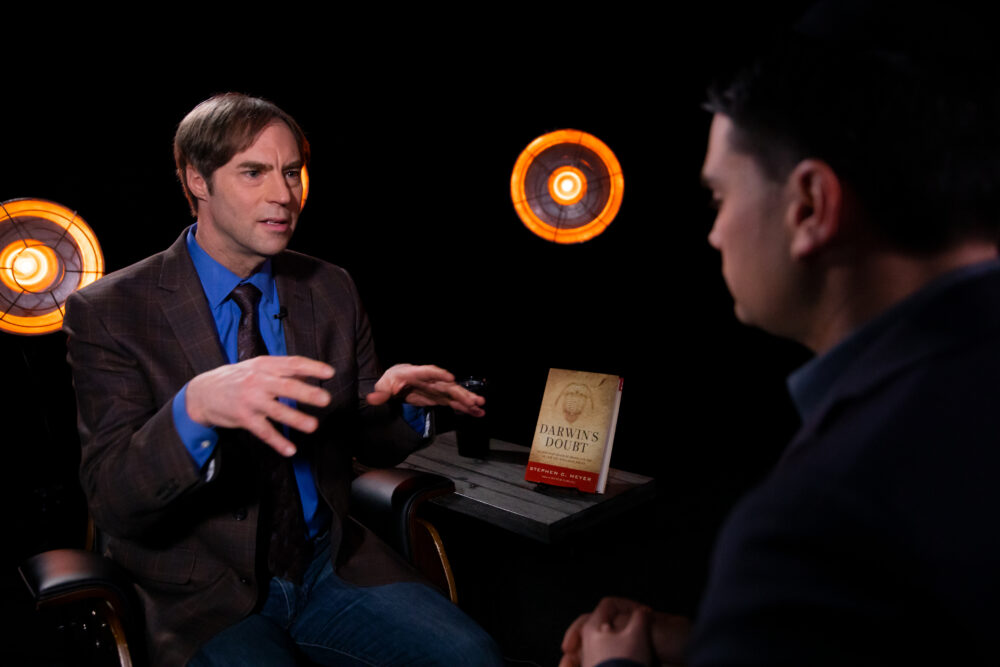
Steve at Ben Shapiro Studio 5

Stephen Meyer & Ben Shapiro Discuss the Origin of Information

On this episode of ID The Future, we’re bringing you the concluding half of a 2019 interview between Daily Wire host Ben Shapiro and philosopher of science Dr. Stephen C. Meyer. The conversation is now five years old, so it's a good time to dust it off and share it with those who may have missed it or forgotten about it. In Part 2, Shapiro and Meyer discuss the origin of life and the origin of information. They also touch on the evidence for fine-tuning in the universe and the problems with the multiverse. This is Part 2 of a two-part interview. Read More ›
IDTF Stephen Meyer Ben Shapiro 2019 Interview Podcast Post Graphic

Stephen Meyer and Ben Shapiro Talk Intelligent Design

On this ID The Future, we bring you the first half of Daily Wire host Ben Shapiro’s 2019 interview with philosopher of science Dr. Stephen Meyer on The Ben Shapiro Sunday Special. This exchange happened five years ago now, and we thought it was a good time to put it out there again for those who may not have heard it yet or don’t remember it. Dr. Meyer considers this one of the best interviews he’s done on the subject of his second solo book Darwin’s Doubt. Shapiro was very well-prepared and asked great questions, resulting in a thought-provoking and thoroughly engaging hour-long conversation. We’ve got the first half of it for you today, followed by the concluding half in Read More ›

IDTF Guillermo Gonzalez 20th Anniversary Edition Privileged Planet Interview Post Graphic
Image Credit: nuttawutnuy - Adobe Stock

Guillermo Gonzalez on 20th Anniversary Edition of The Privileged Planet

In 2004, Dr. Jay Richards and Dr. Guillermo Gonzalez published a bold hypothesis: not only is Planet Earth well-suited for advanced life like ourselves, it’s also finely tuned for scientific discovery. Materialists call it a cosmic coincidence, but the array of evidence Richards and Gonzalez marshal in support of their argument suggests otherwise. On this ID The Future, host Andrew McDiarmid sits down with Dr. Guillermo Gonzalez to discuss his newly revised, rewritten, and updated twentieth anniversary edition of The Privileged Planet. Read More ›
america-planet-earth-globe-stockpack-adobe-stock
America planet Earth globe
Image Credit: 1xpert - Adobe Stock

Jay Richards on New Expanded Edition of The Privileged Planet

In 2004, Dr. Jay Richards and Dr. Guillermo Gonzalez published a bold hypothesis: not only is Planet Earth well-suited for advanced life like ourselves, it's also finely tuned for scientific discovery. Materialists put this down to cosmic coincidence, but the array of evidence Richards and Gonzalez marshal in support of their argument suggests otherwise. On this episode of ID The Future, host Andrew McDiarmid speaks with Dr. Jay Richards about his work on a revised, rewritten, and updated 20th anniversary edition of The Privileged Planet. Read More ›
man-with-astronomy-telescope-looking-at-the-stars-stockpack-adobe-stock
Man with astronomy  telescope looking at the stars.
Image Credit: allexxandarx - Adobe Stock

A Universe Charged with Meaning and Purpose

In 1936, Albert Einstein wrote that "the fact that [the world] is comprehensible is a miracle." But why is the universe comprehensible to us? And is it an evolutionary fluke or a hallmark of design? On this episode of ID The Future, we’re sharing a recent conversation between Dr. Jonathan Witt and author and teacher Dr. Ken Boa. The topic is Dr. Witt's book A Meaningful World: How the Arts and Sciences Reveal the Genius of Nature. In this discussion, Dr. Witt and Dr. Boa discuss the meaning and purpose inherent in our comprehensible universe, with examples from mathematics, literature, architecture, and more. Read More ›
man-in-field-with-question-mark-stockpack-adobe-stock
Man in field with question mark
Image Credit: Alexandr - Adobe Stock

The Imploding of an Atheist Professor’s Worldview
For 25 years, Dr. John D. Wise considered Darwinian evolution the most plausible explanation for life's origin and development. But as he studied the latest evidence in molecular biology, genetics, astronomy, and other fields, he began to realize that modern science was confirming many of the predictions and arguments of intelligent design. On this ID The Future, host Andrew McDiarmid talks with professor and author Dr. John D. Wise about his surprising journey from atheism to Christianity. Read More ›
galaxy-cluster-elements-of-this-image-furnished-by-nasa-stockpack-adobe-stock
Galaxy cluster. Elements of this image furnished by NASA
Image Credit: Supernova - Adobe Stock

Stephen Meyer on the Explanatory Power of Intelligent Design

On this episode of ID The Future, we’re sharing the second half of an interview between philosopher of science Dr. Stephen Meyer and author and radio/podcast host Justin Brierley. The interview delves into the main arguments of Dr. Meyer’s most recent book Return of the God Hypothesis, but it also serves as an update on the status of intelligent design and the growing interest in design arguments in both academia and the public square. In part 2, Meyer refutes the multiverse hypothesis and explains why naturalistic theories of the origin of life fall short. We are grateful to Justin Brierley for permission to share this interview on ID The Future. Catch more of Brierley's interviews at justinbrierley.com. Read More ›