Stephen Meyer on Good Questions and a God Hypothesis
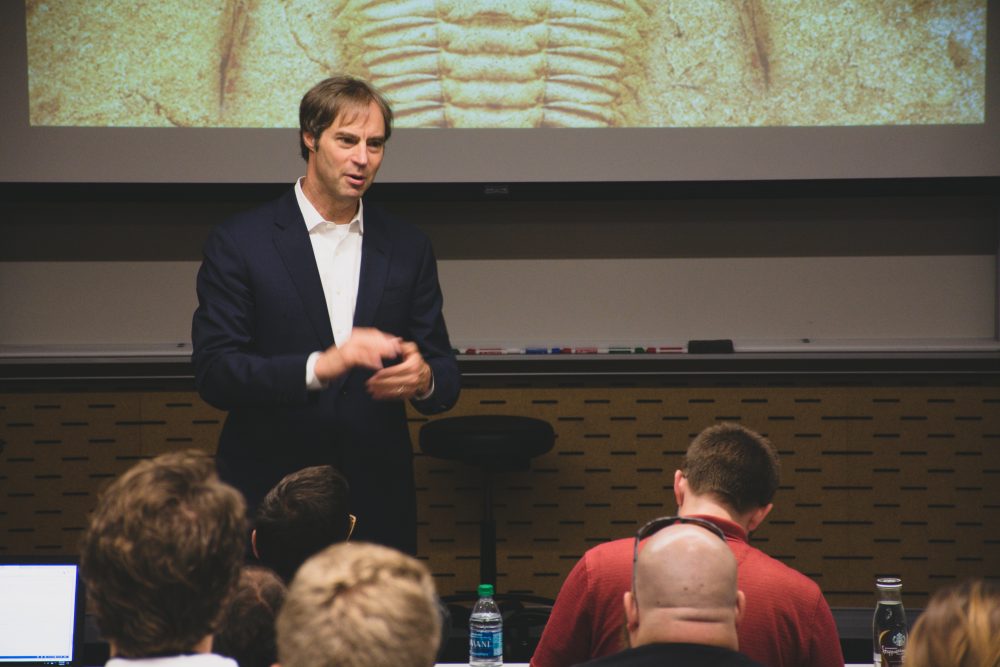
On this episode of ID the Future, Cambridge-trained bestselling author Stephen Meyer discusses some good questions posed to him at a recent science seminar he lectured at in Seattle.
Read More ›On this episode of ID the Future, Cambridge-trained bestselling author Stephen Meyer discusses some good questions posed to him at a recent science seminar he lectured at in Seattle.
Read More ›
On this episode of ID the Future, Stephen Meyer, Director of the Center for Science and Culture, discusses the two lectures he gave to a private audience at Discovery Institute’s 2019 Summer Seminar on Intelligent Design. One talk focused on the fossil record, and the other on the Big Bang.

Today’s episode of ID the Future brings you a conversation between Discovery Institute senior fellow Jonathan Witt and radio host Jerry Newcombe, originally presented on Newcombe’s nationally syndicated radio show. The two begin by discussing Discovery Institute’s Science Uprising video series, which Jonathan helped create. From there they go on to talk about philosophical materialism, free will, morality, and what it means to be human. They touch on the Darwinian opposition, and on the rising threat of censorship.

On this episode of ID the Future, attorney Herman Bouma tells the story of how his talk at a National Association of Science Teachers conference last April was canceled at the last minute. His talk highlighted how Darwin’s Origin of Species (sixth edition) set an example of engaging his scientific critics with civility and reason. Bouma says in response to the incident, “It’s almost as if they considered Darwin a threat to Darwinian evolution.” Three conference officials shut him down, accusing him of promoting fake science. As Bouma notes, Darwin wrote that “I look with confidence to the future, to young and rising naturalists, who will be able to view both sides of the question with impartiality.” Alas, Darwin’s example Read More ›

On this episode of ID the Future, Bijan Nemati, formerly of CalTech’s Jet Propulsion Laboratory and now at the University of Alabama, Huntsville, tells what science is learning about how hard it is to find a planet like Earth. Anywhere. The more we learn about the conditions necessary for a planet to host life, the more we see we may need to search at least tens of thousands of Milky Way galaxies to expect to find another one — at least if it all depends on blind luck. This talk is part of bonus material included with the new, thought-provoking series Science Uprising.
On this episode of ID the Future we hear commentary on the singularity from Frank Tipler, Professor of Mathematical Physics at Tulane University and co-author of The Anthropic Cosmological Principle.
Read More ›
On this episode of ID the Future, Michael Egnor interviews philosopher Edward Feser about Feser’s new book Aristotle’s Revenge: The Metaphysical Foundations of Physical and Biological Science. Scientists can get along without Aristotle’s metaphysics, says Feser, but science can’t; in fact science presupposes Aristotle. Mechanistic views of nature have tried to make nature nothing but particles interacting, but a full understanding of nature requires that we include Aristotelian purpose, or teleology, and essences as well. Ultimately, Feser suggests, this leads us toward evidence for a divine mind behind it all.
On this episode of ID the Future, Andrew McDiarmid continues his conversation with distinguished Brazilian scientist Marcos Eberlin, author of close to 1,000 scientific articles and the Nobel laureate-endorsed Foresight: How the Chemistry of Life Reveals Planning and Purpose. Their topic again is the body’s surprisingly sophisticated, all-or-nothing system for flushing bad bacteria from our guts.
Read More ›

On this episode of ID the Future we hear a neurosurgeon’s view on materialistic bias afflicting the entire field of neuroscience. It’s a bias, he argues, that leads some scientists to misunderstand the meaning of their experiments. Darwinists “allergic to teleology” ignore clear evidence that purpose is essential to the mind. This talk is bonus material accompanying the action-filled and thought provoking series of short videos on science and materialism at scienceuprising.com.