

ID the Future Intelligent Design, Evolution, and Science Podcast
Topic

laws of physics

Woman kisses her boy on forehead outdoors as they both stay in the war zone after Russia attacked Ukraine.
Image licensed from Adobe Stock

Eric Hedin on Suffering in a Designed World

Is natural evil an argument against intelligent design? And is human evil more consistent with naturalism or theism? On this ID The Future, host Andrew McDiarmid speaks with Dr. Eric Hedin about his recent article "Thoughts of Evil in a Designed World." First, Dr. Hedin discusses the problem of natural evils like earthquakes, hurricanes, droughts, and other natural disasters. He reports that in the last century, the human death toll from such tragedies has dropped as we have learned to mitigate the effects of these natural forces in our lives. Hedin also discusses the impact of sickness on our bodies. "Any complex system can break down," Hedin reminds us, "because we do live in a world where the second law of thermodynamics applies not just to stars and mountainsides and physical systems but also to our own bodies." But suffering, tragic as it can be for all of us to endure, is not inconsistent with design. Then there's the other major cause of suffering in life: human evil. If humans are products of an evolutionary process, we'd expect human evil to more or less match what we see in the animal world. But as recent attacks on the people of Israel starkly demonstrate, that is not the case. We are capable of much worse, as well as much better. Dr. Hedin explains that humans have the gift of rational override, something determinists tend to forget. This is Part 1 of a two-part conversation. Read More ›
James Webb Telescope NASA Image Webb Captures Actively Forming Stars Larger Size
Image downloaded from NASA James Webb Telescope Gallery. Credit: NASA, ESA, CSA.

How Modern Physics Reveals Purpose in the Universe

Scientists agree that our universe is finely tuned for the existence of life. But is the fine-tuning a happy accident or the result of foresight? On this ID The Future, host Brian Miller continues his conversation with Rabbi Elie Feder and Rabbi Aaron Zimmer, hosts of the Physics to God podcast. Feder has a PhD in mathematics and has published articles on graph theory. Zimmer has training in physics, and has studied mathematics, philosophy, and psychology. Both men also have extensive rabbinical training. Through their podcast, Feder and Zimmer invite both secular and religious listeners on a journey through modern physics as they offer rational arguments for an intelligent cause of the universe. In the conclusion to their discussion, Feder and Zimmer explain why the cosmological constant is one of their favorite examples of fine-tuning. They also share the importance of exploring the teleological causes, or purposes, of natural phenomena. To help listeners grasp the difference between efficient causes and teleological causes, they give the example of a carpenter who builds a table. Is the carpenter the cause of the existence of the table? Or is the idea of the table in the carpenter's mind the cause? Or both? Using modern physics, say Feder and Zimmer, an objective justification for the purpose of the universe can be made. Enjoy this provocative and illuminating discussion! Don't miss Part 1 of the conversation, available here: https://idthefuture.com/1787/ Read More ›
bright-blue-electromagnetic-field-in-space-isolated-on-black-background-stockpack-adobe-stock
Bright blue electromagnetic field in space isolated on black background.
Image Credit: AGPhotography - Adobe Stock

Physics to God: Rational Arguments for Design in the Universe

Do you recognize the number 1/137.035999206? It might seem arbitrary, but if the fine structure constant were any higher or lower than it is, you might not exist! On this episode of ID The Future, host Brian Miller kicks off an engaging conversation with Rabbi Elie Feder and Rabbi Aaron Zimmer, hosts of the Physics to God podcast. Feder has a PhD in mathematics and has published articles on graph theory. Zimmer has training in physics, and has studied mathematics, philosophy, and psychology. Both men also have extensive rabbinical training. Through their podcast, Feder and Zimmer invite both secular and religious listeners on a journey through modern physics as they offer rational arguments for an intelligent cause of the universe. In Part 1 of a two-part discussion, Feder and Zimmer share their background and the inspiration for their podcast. They also explain their focus on the constants of physics - specific numbers and values built into the laws of nature that are the same everywhere. What do these numbers mean? How are they measured? Why are they important? Do they hint at design, or are they "magic numbers that come to us with no understanding," as noted physicist Richard Feynman put it? A physicist himself, Miller is the perfect host to unpack the efforts of Feder and Zimmer. It's time to get more intimately acquainted with the strange and wonderful numbers that hold our universe together! Read More ›
cosmos
Image Credit: Sergey Nivens - Adobe Stock

Casey Luskin on Why Intelligent Design is Worth Defending

Today’s ID the Future spotlights The Comprehensive Guide to Science and Faith. Host Eric Anderson interviews one of the anthology’s co-editors and contributors, geologist Casey Luskin. The two focus on just one of Luskin’s contributed essays, one that addresses two primary questions: Is intelligent design true? And is it worth expending the energy to defend it against powerful opposition? Luskin answers both questions in the affirmative, and explains why he sees the new anthology as a great resource in the cause of intelligent design.

RGH cover no text
Return of the God Hypothesis, ROGH, Meyer

Andrew Klavan and Stephen Meyer Talk God and Science

On this ID the Future Stephen Meyer sits down with talk show host and bestselling novelist Andrew Klavan to discuss Meyer’s Return of the God Hypothesis. In this fast-paced conversation the pair touch on the Judeo-Christian roots of science, how fine tuning in physics and cosmology point to intelligent design, and how a great many scientists held out hope that the universe was eternal and therefore did not require a creator, but eventually threw in the towel as evidence mounted for a cosmic beginning. What about the multiverse hypothesis as an escape for atheists wishing to explain away the evidence for a cosmic designer? Meyer explains why it fails Occam’s Razor, and then he and Klavan discuss a noted atheist Read More ›

RGH cover no text
Return of the God Hypothesis, ROGH, Meyer

Pt. 4: Stephen Meyer and Skeptic Michael Shermer

This ID the Future wraps up a lively four-part series between religious skeptic Michael Shermer and Return of the God Hypothesis author and philosopher of science Stephen Meyer. Here Meyer underscores the fact that every worldview must posit something as the prime reality, and he argues that positing mind (rather than matter) as the prime reality solves far more problems in science, and not just in origins science. What about the idea of a multiverse to explain the fine tuning of the laws and constants of physics? Meyer concedes that this is a solution of sorts, but it comes at a tremendous cost, which he explains. That’s just a taste of where Meyer and Shermer go in this final segment. Read More ›

boys stars
Image Credit: grandfailure - Adobe Stock

Jay Richards Talks God, Carl Sagan, and Word Games

On today’s ID the Future, philosopher Jay Richards, co-author of The Privileged Planet, continues a conversation with host Eric Anderson about Carl Sagan and a short video clip where Sagan fields questions about God. Sagan points out that there are different conceptions of God, but Jay asks, what’s his point? There are different conceptions of nature. That doesn’t mean that nature isn’t out there and that there aren’t true and false things that can be said about it. Also, when the vast majority of people speak about God, they have in mind a powerful, conscious Creator of nature. Sagan plays definitional games by redefining the meaning of “God.” Listen in to learn how, to what purpose, and to hear what Read More ›
Summer-Seminar-2019-5327-6000px

Stephen Meyer on His CSC Summer Seminar Talks

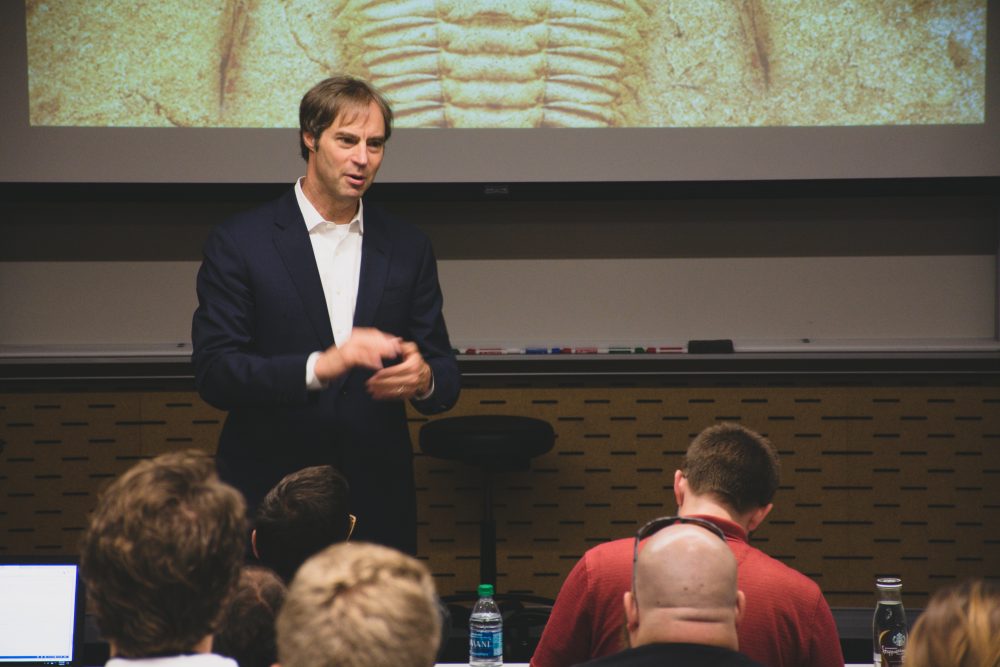
On this episode of ID the Future, Stephen Meyer, Director of the Center for Science and Culture, discusses the two lectures he gave to a private audience at Discovery Institute’s 2019 Summer Seminar on Intelligent Design. One talk focused on the fossil record, and the other on the Big Bang.

IDTF-thumbnail
IDTF-thumbnail

Granville Sewell on Cosmic Origins and Mathematics’ Connection to the Sciences

On this episode of ID the Future, Casey Luskin interviews mathematician Granville Sewell on the multiverse hypothesis, the fine tuning of the laws of physics, and the connections between mathematics and the sciences.

Read More ›
IDTF-thumbnail
IDTF-thumbnail

An Atheist Considers the Scientific Arguments for Intelligent Design

On this episode of ID the Future Casey Luskin interviews atheist philosopher Bradley Monton on the scientific arguments for intelligent design and whether or not he finds them compelling, from design in biology to the fine-tuning of the laws of physics, and what he thinks about evolution and intelligent design in public education.

Read More ›