ID the Future Intelligent Design, Evolution, and Science Podcast
Topic

Philosophy

Colorful chrysanthemum flower close-up. Macro shot. Summer and spring multi-color floral background.
Image licensed from Adobe Stock

Design-Assisted Evolution: A Response to Rope Kojonen

Can evolution and design be wedded in a happy marriage? On this ID The Future, host Casey Luskin kicks off a series of interviews responding to theologian Dr. Rope Kojonen's proposal that front-loaded design and a full-blooded evolutionary process worked together in harmony to produce the diversity of life we find on earth. Here, Luskin interviews Dr. Stephen Dilley, lead author of a comprehensive critique of Kojonen's model co-authored with Luskin, Brian Miller, and Emily Reeves published in the journal Religions. This is Part 1 of a two-part conversation. Look for Part 2 next! Read More ›
peacock feather close up. Peafowl feather background. Mor pankh. Beautiful feather.

A Philosopher’s Defense of Intelligent Design

At its core, intelligent design is the science of detecting design. It's a broadly accepted method used by scientists of all stripes in a variety of scientific disciplines. But when design hypotheses are applied to biology, cosmology, or physics, some claim it's no longer a scientific pursuit. On this ID The Future, host Andrew McDiarmid talks to philosopher and author Peter S. Williams about his recent book An Informed Cosmos: Essays on Intelligent Design Theory. Read More ›
Thomas Doughty - Fanciful Landscape 1834 - NGA 1963.9.2
Thomas Doughty Fanciful Landscape 1834, National Gallery of art, Public Domain

Stephen Meyer: Evidence of Mind in The Natural World

Can we scientifically detect the activity of a mind behind the universe? On this ID The Future, philosopher of science Dr. Stephen Meyer answers this question and more in the concluding hour of a new two-hour interview on various topics related to his work and books. Dr. Meyer discusses the problems with scientific materialism, the problems with quantum cosmological models, a good theology of nature, and more. This is Part 2 of a two-part interview. Read More ›
Martin Johnson Heade 1871 Painting Cattleya_orchid_and_three_hummingbirds_1982.73.1 (public domain, via National Gallery of Art
Image downloaded from National Gallery of Art, Public Domain

Stephen Meyer: Scientific Arguments for a Theistic Worldview

Are there strong scientific arguments for theism? Is there such a thing as objective morality? How is a worldview built? On this ID The Future, philosopher of science Dr. Stephen Meyer answers these questions and more in the first hour of a new two-hour interview on various topics related to his work and books. Dr. Meyer answers questions related to worldview, consciousness, arguments for theism, objective morality, materialism, the nature of information, and more. This is Part 1 of a two-part interview. Read More ›
the-study-of-the-origin-evolution-and-structure-of-the-universe-as-a-whole-stockpack-adobe-stock
The study of the origin, evolution, and structure of the universe as a whole
Image Credit: SUPHANSA - Adobe Stock

Uncovering the Hidden Mathematical Structure of the Universe

Do humans project mathematical order onto nature? Or was it there all along? On this ID The Future, host Andrew McDiarmid concludes his conversation with Dr. Melissa Cain Travis about her recent book Thinking God’s Thoughts: Johannes Kepler and the Miracle of Cosmic Comprehensibility. In Part 3, we look at how Kepler's ideas and work can inform the scientific enterprise today. Many scientists recognize the mystery of cosmic comprehensibility, including such respected voices as Albert Einstein, Sir Roger Penrose, and Paul Davies. Materialists remain agnostic or put it down to chance. But there's a more satisfying explanation, says Travis. "Centuries ago, Kepler already held the trump card. Science itself...can't be explained within the framework of scientific materialism." Genuine human rationality - the very thinking that helped fuel the enormous success of the natural sciences - would not exist if a naturalistic account of the human mind were correct. To get an intellectually satisfying answer for the cosmic comprehensibility we enjoy as humans, we have to think outside the materialist box. Travis explains how we can do that using Kepler's tripartite harmony of archetype, copy, and image. It turns out Keplerian natural theology is more robust than ever before and can help us make sense of the mysteries of our age, including the multiverse, the limits of AI, transhumanism, and more. This is Part 3 of a 3-part discussion. Read More ›
composite-image-of-solar-system-against-white-background-3d-stockpack-adobe-stock
Composite image of solar system against white background 3d
Image Credit: vectorfusionart - Adobe Stock

Kepler’s Pursuit of a Mathematical Cosmology

Why is the cosmos intellectually accessible to us? On this ID The Future, host Andrew McDiarmid continues his conversation with Dr. Melissa Cain Travis about her recent book Thinking God’s Thoughts: Johannes Kepler and the Miracle of Cosmic Comprehensibility. In Part 2, Travis illuminates Kepler's university years to show us how his study of mathematics and astronomy complemented his interest in theology. We learn about obstacles he overcame during his education and how an unexpected appointment to assist imperial mathematician Tycho Brahe jump-started his career as an astronomer and gave him the tools he needed to develop and advance his revolutionary ideas. Travis unpacks Kepler's major works, from Mysterium Cosmographicum to his magnum opus Harmonices Mundi. She also tracks for us the progression of Kepler's ideas to show us how he became a key figure in the transition from ancient astronomy to a true celestial physics. This is Part 2 of a 3-part discussion. Read More ›
colorful-sunset-on-top-of-austrian-mountain-alps-stockpack-adobe-stock
colorful sunset on top of austrian mountain alps
Image Credit: A2LE - Adobe Stock

The Return of Natural Theology

Influenced by a long line of materialist thinkers, Charles Darwin proposed the mechanism of natural selection as a substitute for God. But how does his theory’s explanatory power measure up to recent scientific discoveries? On this ID The Future, physicist Brian Miller discusses the resurgence of natural theology in modern science with Pat Flynn, co-host of the Philosophy for the People podcast. Natural theology advances arguments for God based on reason and the discoveries of science. It’s an ancient pursuit that fell out of favor in the 19th century as a materialist account of life’s origins took center stage. But scientific findings of the last century point to mind, not a mindless process, as the likeliest explanation for a life-friendly universe. As a result, the pendulum is swinging back to teleology, ushering in a new heyday for natural theology. In addition to giving an historical overview of natural theology, Dr. Miller and Flynn also discuss fundamental problems in origin of life studies that demand a better explanation than materialists can offer. Miller speaks plainly about the problem: “Here’s the fundamental challenge,” he says. “All natural processes tend to create greater disorder (entropy)…The origin of life requires chemicals to go into a state of both high order and high energy. That never happens without help!” This is Part 1 of a 2-part discussion. With thanks to Pat Flynn and the Philosophy for the People podcast for permission to share this interview. Read More ›
composite-image-of-composite-image-of-dna-helix-stockpack-adobe-stock
Composite image of composite image of dna helix
Image Credit: vectorfusionart - Adobe Stock

Design or Chance? Casey Luskin on The Andrew Klavan Show

On this ID The Future, we're pleased to share Daily Wire host Andrew Klavan's recent interview with Dr. Casey Luskin. Klavan loves science, but he smells a rat when famous scientists like Richard Dawkins use their displaced authority to make proclamations about science's relationship with religion. So after reading Luskin's recent Daily Wire article about progressives and their long history of banning intelligent design from the classroom, Klavan invited Luskin on his show to help his viewers better understand the theory of intelligent design and the reality of the evolutionary paradigm. Luskin starts with the meanings of evolution and the questions that guide intelligent design researchers. He cites plenty of examples of design from biology and cosmology. Klavan then asks how badly people get censored for considering design perspectives in their work. Luskin explains, using the case of physicist Eric Hedin and his treatment at Ball State University as an example. Luskin rounds out the conversation by explaining how intelligent design uses the scientific method to detect the hallmarks of design in both living systems and the universe at large. "Science never gives us, under any conditions, absolute certainty," Luskin notes. "What it can allow us to do, though, is we can use the methods of historical sciences to infer the best explanation for a given situation given what we know about how the world works." Read More ›
Wells Online Course HOME PAGE Graphic

Jonathan Wells Evaluates Darwinian Evolution in New Online Course

How strong is the evidence for Darwinian evolution? What are the limits of the Darwinian mechanism? How should concepts like evolution and science best be defined? On this episode of ID The Future, we bring to you the first three video lectures from a new online course by molecular and cell biologist Jonathan Wells. In the first brief lecture, Wells explains his own evolution; the evolution of his thinking about evolution, that is. You'll glean some interesting details about Wells's career here. In the second lecture, Wells defines the word evolution by reminding us of its various meanings and uses. He also describes how Darwin's theory of natural selection became the framework that bolstered a materialistic metaphysic that endures today. You'll learn that Darwin's proposal relied less on evidence-based science and more on theological and philosophical arguments. In the third lecture, Wells defines science, and explains what happens when the definition of science is confined to naturalistic explanations only. Every so often, says Wells, enough data accumulates to present a challenge to the prevailing scientific framework. It happened in Newton's day. It happened in Darwin's day. And it may happen again soon, if the mounting evidence supportive of intelligent design is any indication. Learn more about Wells's online course at discoveryu.org. Over 40 short video lectures, Wells explains the major concepts of both chemical and biological evolution, and he critically assesses the evidence for evolution offered by genetics, developmental biology, fossils, and more. Wells deals with some of the most popular “icons” of evolution found in standard textbooks, including Darwin’s finches, whales, antibiotic resistance, peppered moths, “junk” DNA, and more. Read More ›
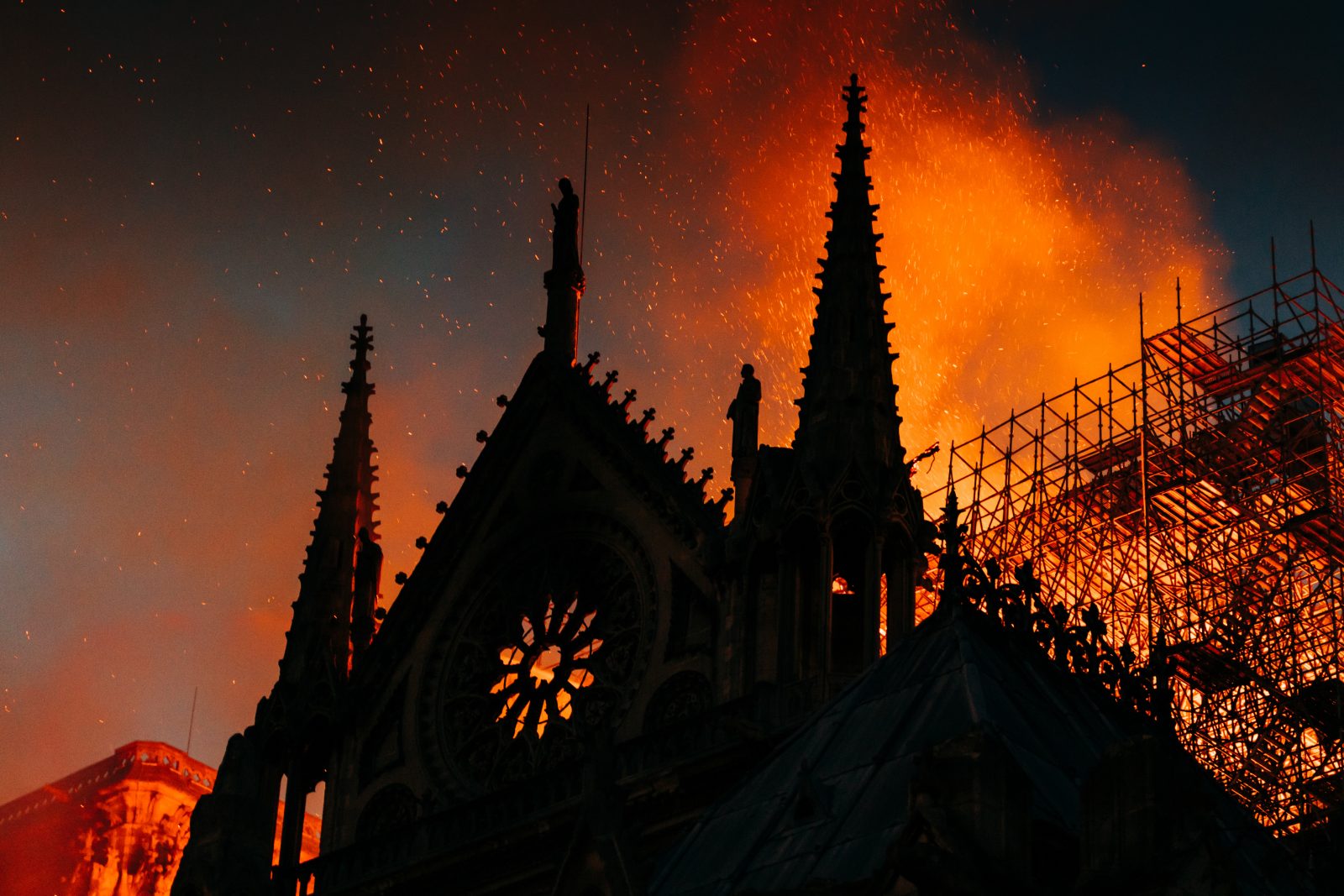
Notre Dame fire
Image Credit: Guillaume - Adobe Stock

David Berlinski on the Universal Civilization, Architectural Decline, and Fleeing the Nazis

On this ID the Future, host Wesley J. Smith talks with polymath and Human Nature author David Berlinski about the philosophy of mathematics, the corruption of science, the burning of Notre Dame, modern Europe’s curious incapacity to build graceful, beautiful structures, and what’s driving the devolution of Western society. But before any of that, Berlinski relates the dramatic story of how his parents, European Jews, escaped the Nazis only by the skin of their teeth. This is Part 1 of a two-part conversation borrowed with permission from Wesley J. Smith’s Humanize podcast.