ID the Future Intelligent Design, Evolution, and Science Podcast
Topic

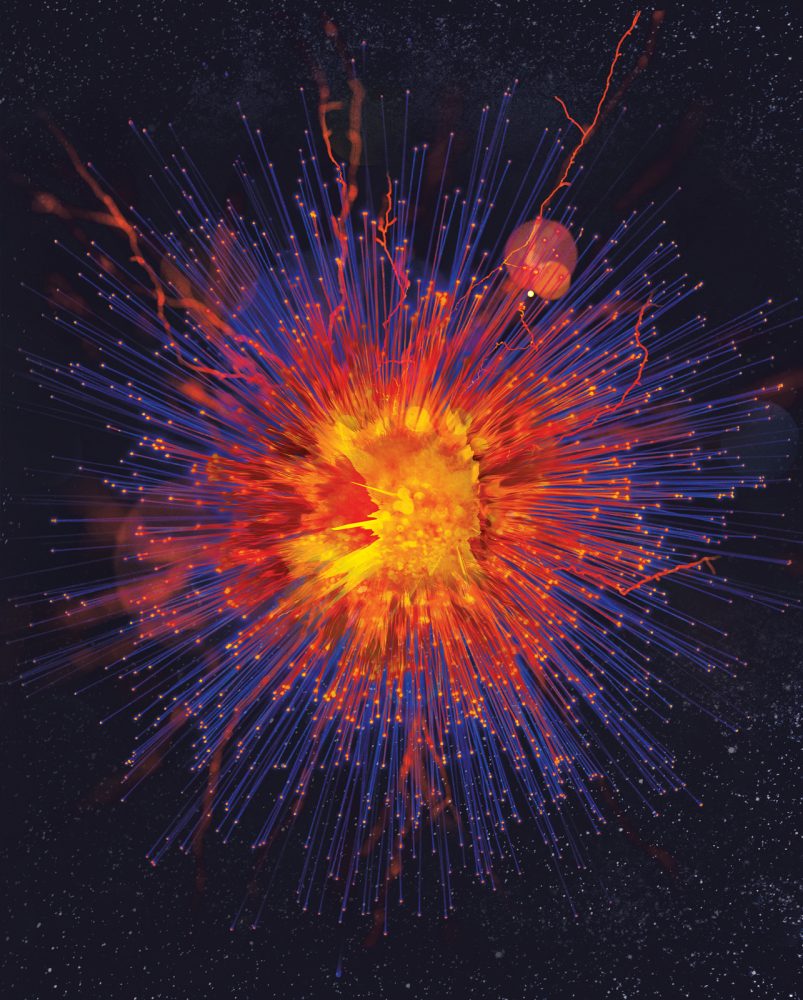
Big Bang

RGH cover no text
Return of the God Hypothesis, ROGH, Meyer

Stephen Meyer Defends His New Book to Cosmologist Brian Keating, Pt. 2

Today’s ID the Future continues (by permission) the long-form conversation between Stephen Meyer, author of the newly released USA Today bestseller Return of the God Hypothesis, and UC-San Diego physicist Brian Keating. Here in part two the conversation turns to quantum cosmology, multiverse hypotheses, Stephen Hawking, and Hawking’s now-you-see-it/now-you-don’t use of imaginary time to deny a cosmic beginning. Meyer argues that Hawking’s imaginary-time trick doesn’t wash, there remains powerful evidence for a cosmic beginning, and that this beginning is best explained as the creation act of an intelligent, immaterial being. Also, Keating and Meyer tackle the question: Did Isaac Newton really blunder by invoking a God of the gaps to periodically tweak the solar system to smooth out perturbations? That is, was Newton led Read More ›

RGH cover no text
Return of the God Hypothesis, ROGH, Meyer

Stephen Meyer Defends His New Book to Cosmologist Brian Keating, Pt. 1

Today’s ID the Future features, by permission, the first part of a long-form conversation between Stephen Meyer, author of the newly released Return of the God Hypothesis, and Brian Keating, the Chancellor’s Distinguished Professor of Physics at the Center for Astrophysics & Space Sciences at the University of California, San Diego. Do the laws of cosmology, physics, and biology exhibit dispositive evidence of a cosmic designer? Do the Big Bang and fine tuning suggest a “Mind” behind it all? In the book and in this conversation Meyer argues yes. Keating tells what he likes about the new book and draws on his deep knowledge of cosmology to press Meyer with some great followup questions. Check out Keating’s website here, and Read More ›

stained glass God creating.jpg
Zegiestow, Poland. 2019/8/10. Stained-glass window depicting the Creation of the World with the words
Image Credit: Adam Ján Figeľ - Adobe Stock

Michael Medved and Stephen Meyer on the Return of the God Hypothesis

Today’s ID the Future features, by permission, a recent conversation between radio show host Michael Medved and philosopher of science Stephen Meyer as they discuss Meyer’s new book, Return of the God Hypothesis. Listen in as Meyer, director of Discovery Institute’s Center for Science and Culture, provides a swift flyover of 500 years of scientific history, in which he traces the rise, fall, and rise again of a paradigm Meyer refers to as “the God hypothesis.” To learn more about Meyer’s new book and see the growing list of enthusiastic reviews from top scientists, go to ReturnoftheGodHypothesis.com.

big-bang-illustration.jpg
Image Credit: SantaPa design - Adobe Stock

Physicist Eric Hedin: Cosmology Points to Cosmic Design

On this ID the Future host Eric Anderson continues his conversation with physicist and Canceled Science author Eric Hedin. Here Hedin argues that the dogmatic rule that natural science should only ever invoke natural causes has at its heart a logical problem. He and Anderson also review some startling cases of fine-tuning for life and why a “theory of everything” would not solve the fine-tuning problem for atheists but merely move it back to the theory of everything itself. Also in today’s conversation, a highly accessible flyover of how scientists came to realize that the universe wasn’t eternal but had had a beginning. Hedin also tackles a theological poser: If the universe was designed for life, why did the designer Read More ›

sorbo-lennox-against-the-tide
Original image: sorbo-lennox-against-the-tide-1.jpg

John Lennox Against the Tide of Atheism

On this ID the Future, John Lennox tells about discovering the damage atheism does to people, by seeing it firsthand in communist Eastern Europe and the former Soviet Union, and seeing what it does to rationality itself. In his continuing conversation with host and philosopher of science Stephen Meyer, Lennox relates how in his interactions with famous religiously skeptical scientists, he emphasizes that the Judeo-Christian worldview did much to give us science. When skeptical scientists ask the Oxford mathematician and philosopher how Christianity could have anything to say to science, Lennox is ready with an answer. This is the second part of a three-part conversation in which Lennox discusses his new documentary, Against the Tide, filmed with actor and host Read More ›

nanocosmos.jpg
Quantum physics, time quantum travel. Nanocosmos, nanoworld
Image Credit: Peter Jurik - Adobe Stock

James Tour and Stephen Meyer on the Origin of Life, Pt. 3

On this episode of ID the Future, Rice University synthetic organic chemist and inventor James M. Tour continues his conversation with Stephen C. Meyer. Read More ›
chemistry overlay plant.jpg
Biology.
Image Credit: BillionPhotos.com - Adobe Stock

James Tour and Stephen Meyer on the Origin of Life, Pt. 1

On this episode of ID the Future,  James M. Tour and Stephen C. Meyer begin a discussion about the hard problems facing researchers trying to discover how the first life could have come about naturalistically. Meyer is the director of the Center for Science and Culture; Tour is a world-renowned synthetic organic chemist with over 700 research publications and multiple major recognitions, including TheBestSchools.org naming him one of the 50 most influential scientists in the world today. Though he doesn’t sign on to ID theory, he says he’s sympathetic with the idea, and certainly not impressed with any naturalistic explanations for the origin of life. In this first of a three-part series, they explore problems ranging from the extreme improbabilities associated with protein assembly, Read More ›

radio tuner.jpg
Classic radio tuner panel close-up. Black background
Image Credit: Sensay - Adobe Stock

Fine Tuning in a Nutshell: No Problem

On this episode of ID the Future, Andrew McDiarmid interviews Robert Alston, Ph.D electrical engineer working at Picatinny Arsenal and co-author of the new book Evolution and Intelligent Design in a Nutshell. The two discuss the origin of the Nutshell book and the origin and fine tuning of the universe. Though cosmic fine tuning is often referred to as “the fine tuning problem,” Alston says it’s really no problem at all — not unless you’re trying to shoehorn it into the box of philosophical materialism.

Abstract neon background. luminous swirling. Glowing spiral cover. Black elegant. Halo around. Power isolated. Sparks particle. Space tunnel. Glossy jellyfish. LED color ellipse. Glint glitter

Kirk Durston on Fantasy Science and Scientism — Pt. 3 of 3

On this episode of ID the Future, Kirk Durston, a biophysicist focused on identifying high-information-density parts of proteins, completes a three-part series on three categories of science: experimental, inferential, and fantasy science. Fantasy science makes inferential leaps so huge that virtually none of it is testable, either by the standards of experimental science or by those of the historical sciences, which reason to the best explanation by process of elimination. One example of fantasy science, according to Durston, is the multiverse. As he insists, an imaginative story largely untethered from evidence and testing but told using math instead of literary devices is still an imaginative story untethered from evidence and testing. Scientism, “atheism dressed up in a lab coat,” can lead Read More ›

Summer-Seminar-2019-5327-6000px

Stephen Meyer on His CSC Summer Seminar Talks

On this episode of ID the Future, Stephen Meyer, Director of the Center for Science and Culture, discusses the two lectures he gave to a private audience at Discovery Institute’s 2019 Summer Seminar on Intelligent Design. One talk focused on the fossil record, and the other on the Big Bang.