
How the Myth of Junk DNA Hindered Science

Design-Assisted Evolution: A Response to Rope Kojonen

Carl Sagan Wrong about “Pale Blue Dot,” Says Astrobiologist
The Dawkins Test Returns an Answer: Intelligent Design
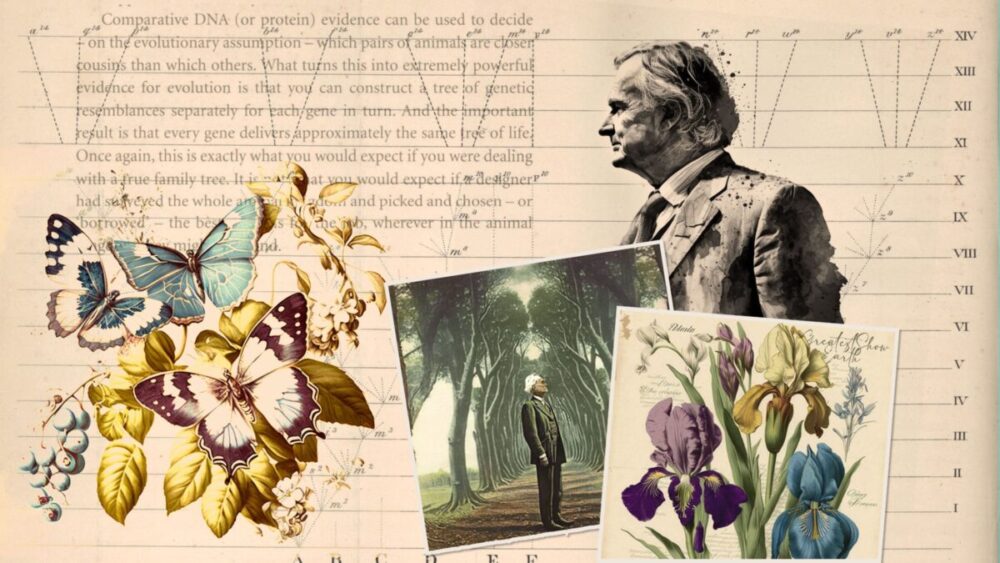
In 2009 atheist biologist Richard Dawkins offered a scientific test to decide between Darwinian evolution and intelligent design (ID). The results are in, and as guest Casey Luskin explains on this ID the Future, the evidence has broken strongly in favor of intelligent design. At the time Dawkins presented the test, he was confident that comparative DNA evidence supported Darwin’s tree of life and its idea of universal common ancestry. He made the point in his 2009 book The Greatest Show on Earth and in two interviews. As he put it, “The single most convincing fact or observation you could point to” in favor of Darwinian evolution over against ID “would be the pattern of resemblances that you see when Read More ›
Did the National Science Teaching Association Just Muzzle … Darwin?
What happens when someone tries to present to the National Science Teaching Association (NSTA) Charles Darwin’s top arguments against his own theory? Herman Bouma, founder of the National Association for Objectivity in Science, knows from personal experience. As he relates to host Casey Luskin on this ID the Future, he recently had a poster presentation on the topic accepted for an NSTA conference, but then a defender of Darwinian orthodoxy rushed in and spiked it. Bouma describes the censored presentation and the Kafkaesque back and forth he says he had with the organizer, who ultimately shut him down. Bouma warns of what has been described as the “Censorship Industrial Complex,” but he also says he hasn’t given up trying to Read More ›

The Problem of Earth Privilege: It’s Getting Worse
On today’s ID the Future, astrobiologist Guillermo Gonzalez, co-author of The Privileged Planet, provides a rapid survey of some of the growing evidence that Earth is finely tuned in numerous ways to allow for life. He draws a helpful distinction between local fine tuning and universal fine tuning. And he tells us about the many extra-solar planets astronomers have discovered in recent years and how all that new data continues to undermine the misguided assumption (encouraged by the misnamed “Copernican Principle”) that Earth is just a humdrum planet. Far from it, Gonzalez argues. The conversation is occasioned by Gonzalez’s essay in a newly released anthology, Science and Faith in Dialogue.

Chimp and Human Genomes: An Evolution Myth Unravels
On today’s ID the Future, Casey Luskin rebuts the oft-repeated claim that the human and chimp genomes are 98-99% similar and therefore surely resulted from Darwinian common descent. Luskin cites an article in the journal Science which describes the 98-99% claim as a myth. The original figure was derived from a single protein-to-protein comparison, but once you compare the entire genomes, and use more rigorous methods, the similarity drops several percentage points, and on one account, down into the mid-80s. Additionally, the chimp genomes used in the original comparison studies borrowed the human genome for scaffolding, thus artificially boosting the degree of similarity. What about supposed junk DNA similarities between human and chimp? Why would an intelligent designer put the Read More ›

New South Africa Book Explores Evidence of Design
Today’s ID the Future spotlights a new free online ID book from South Africa, Science and Faith in Dialogue, with contributions from Stephen Meyer, Hugh Ross, Guillermo Gonzalez, James Tour, Fazale Rana, Marcos Eberlin, and others. Geologist Casey Luskin joins host Eric Anderson to tell how the new peer-reviewed book came together and to describe the chapter he contributed, “Evolutionary Models of Palaeoanthropology, Genetics, and Psychology Fail to Account for Human Origins: A Review.” Luskin did his PhD in South Africa and had many opportunities to study various hominid fossils. Here he explains why he is convinced that intelligent design far better explains the fossil evidence than does Darwinian evolution.