

ID the Future Intelligent Design, Evolution, and Science Podcast
Topic

Philosophy

enthusiastic-math-teacher-holding-a-lesson-for-high-school-s-327321121-stockpack-adobestock
Enthusiastic math teacher holding a lesson for high school students
Image Credit: Kuz Production - Adobe Stock

How to Train Up a New Generation of James Clerk Maxwells

Is it possible to produce mathematicians today of the same caliber as greats like Sir Isaac Newton and James Clerk Maxwell? How can we help young people develop a genuine interest in mathematics, including its history, applications, and philosophy? Today on ID The Future, host Andrew McDiarmid concludes his conversation with mathematics educator, curriculum designer, and medical physicist Amos Tarfa. In Part 1, Amos profiled 19th century Scottish mathematician and physicist James Clerk Maxwell to help us better understand the great scientist’s contributions and how they relate to today’s debate over evolution and intelligent design. Here in Part 2, Amos tells us more about his vision for math education and how we can train up the next generation of James Clerk Maxwells. Read More ›
asian-student-doing-research-in-library-using-laptop-in-book-590689444-stockpack-adobestock
Asian student doing research in library using laptop in books, making a project and preparing for exam. Nerdy guy studying his lessons - education, self-study concept close up
Image Credit: andreybiling - Adobe Stock

Bill Dembski: Pursuing Truth and Trust in AI and LLMs

How does AI stack up when it comes to accurately representing the theory of intelligent design? Today, host Andrew McDiarmid speaks with mathematician and philosopher Dr. William Dembski about the reliability and accuracy of large language models (LLMs) like ChatGPT and Bard, particularly concerning intelligent design. This second half of the conversation highlights the importance of independent verification when using AI, as LLMs can “hallucinate” or generate false or biased information. Dembski advises an approach of verify, then trust, turning the old Russian proverb on its head. McDiarmid and Dembski also explore the potential for AI to enhance human capabilities and education if used judiciously, rather than becoming a crutch that erodes critical thinking. But that will require that we Read More ›

chatgpt-chat-with-ai-or-artificial-intelligence-technology-m-589267674-stockpack-adobestock
ChatGPT, Chat with AI or Artificial Intelligence technology. Man using a laptop computer chatting with an intelligent artificial intelligence asks for the answers he wants. Smart assistant futuristic,
Image Credit: Supatman - Adobe Stock

Can AI Accurately Portray Intelligent Design?
How accurately do AI models like ChatGPT, Grok, and Bard portray the theory of intelligent design? Can large language models rise above the biases of sources like Wikipedia to help level the playing field for intelligent design? Today, host Andrew McDiarmid begins a conversation with mathematician and philosopher Dr. William Dembski to address the relationship between AI and ID. In recent years, Dr. Dembski has been putting LLMs through their paces to see if they can accurately and fairly discuss and portray intelligent design arguments and concepts. Here, Dembski discusses what he discovered as he used various methods to interrogate these complex algorithms. This is Part 1 of a two-part conversation. Look for Part 2 in a separate episode. Read More ›
IDTF-2046-Larry-Sanger-Skeptic-To-Believer-Interview-Part-1-
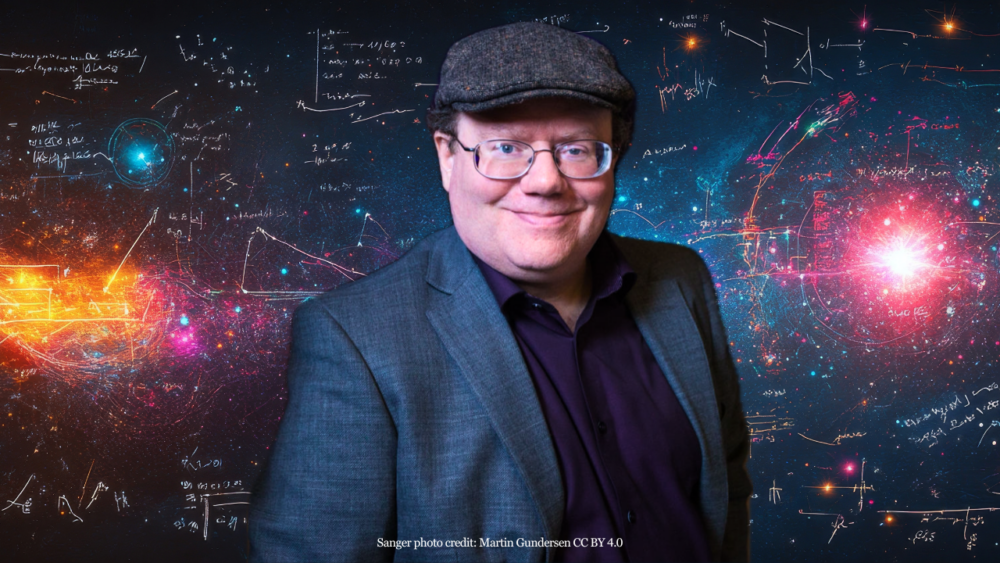
Cosmic Calculus Abstract Background with Glowing Equations and Formulas on a Chalkboard, By Andrei. Licensed from Adobe Stock. Larry Sanger photo courtesy Martin Gundersen, used under CC BY 4.0 license.

Skeptic to Believer: Wikipedia Co-Founder Larry Sanger’s Intellectual Journey
On this ID The Future, Wikipedia co-founder Larry Sanger joins hosts Andrew McDiarmid and Nathan Jacobson to delve into his personal evolution from longtime skeptical philosopher to belief in God. After falling out of faith in his teens, Sanger became a committed skeptic and agnostic, adhering to the principle of methodological skepticism for decades as he evaluated traditional arguments for the existence of God and found them wanting. And while Sanger was unconvinced by the claims of "new atheists" like Richard Dawkins and Daniel Dennett, he found himself drawn to the arguments of intelligent design scientists like Stephen Meyer, Michael Behe, and William Dembski. In this first half of a conversation, Sanger recounts his fascinating intellectual journey while unpacking the intelligent design arguments he found most convincing along his journey. This is Part 1 of a two-part interview. Look for Part 2 in a separate episode. Read More ›
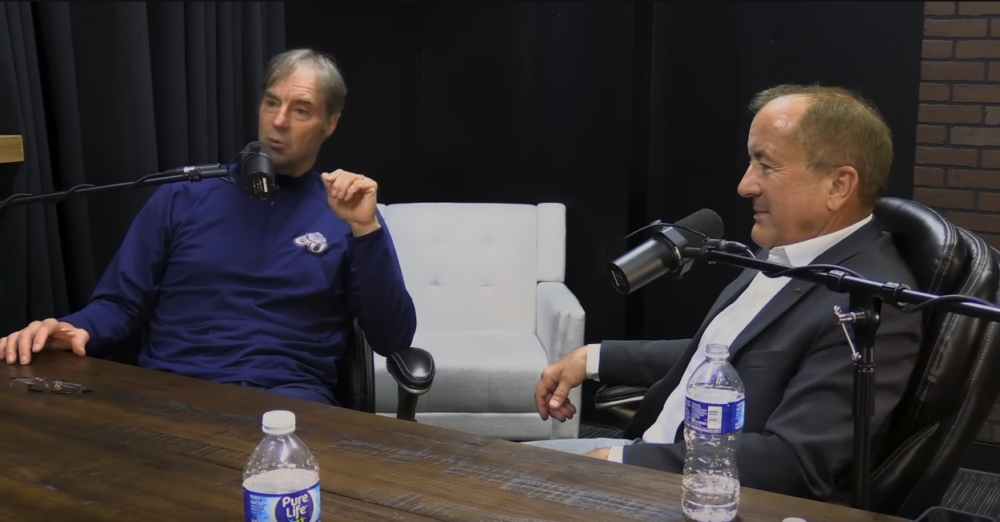
Screenshot 2025-02-17 at 11.49.41 AM
Image courtesy The Bryan Callen Show. Used with permission.

Can Science Find God? Stephen Meyer vs. Michael Shermer

Humans seem to be drawn in a certain direction toward truth and beauty. Is that an accident of nature? Or is there a higher truth prompting it? On this ID The Future, we're pleased to share the first half of an engaging conversation between philosopher of science Dr. Stephen Meyer and historian of science Michael Shermer about science, God, the origin of information, and the nature of mind. The conversation was hosted by comedian and podcaster Bryan Callen on The Bryan Callen Show. In Part 1, Meyer and Shermer discuss arguments for design, the Big Bang, the origin of information, and the role of mind in the universe. This is Part 1 of a two-part interview. Look for Part 2 in a separate episode of ID The Future. We're grateful to the producers of The Bryan Callen Show for permission to share this conversation on ID The Future! Read More ›
Panda Bear Eating Bamboo, Bifengxia Panda Reserve in Ya'an Sichu
Image licensed from Adobe Stock

The Panda’s Thumb: An Extraordinary Instance of Design?

Does the panda's thumb refute intelligent design? Or is it one of the most extraordinary manipulation systems in the mammalian world, as one respected study has found? On this ID The Future, host Casey Luskin speaks with philosopher Dr. Stephen Dilley about his recent paper evaluating the strengths and weaknesses of the iconic panda's thumb argument for evolution. Read More ›
A hummingbird sucks honey from a flower.
Image licensed from Adobe Stock

The Scientific Problems with Kojonen’s Theistic Evolution Model

Can evolution and intelligent design work together in harmony? Or is that wishful thinking? On this ID The Future, host Casey Luskin concludes his conversation with philosopher Dr. Stephen Dilley about a recent proposal to marry mainstream evolutionary theory with a case for intelligent design. Dr. Dilley outlines the scientific problems with Kojonen's proposal and explains why it contradicts our natural intuition to detect design. This is Part 2 of a two-part conversation. Be sure to catch Part 1, and look for more interviews with others on this topic soon. Read More ›
Colorful chrysanthemum flower close-up. Macro shot. Summer and spring multi-color floral background.
Image licensed from Adobe Stock

Design-Assisted Evolution: A Response to Rope Kojonen

Can evolution and design be wedded in a happy marriage? On this ID The Future, host Casey Luskin kicks off a series of interviews responding to theologian Dr. Rope Kojonen's proposal that front-loaded design and a full-blooded evolutionary process worked together in harmony to produce the diversity of life we find on earth. Here, Luskin interviews Dr. Stephen Dilley, lead author of a comprehensive critique of Kojonen's model co-authored with Luskin, Brian Miller, and Emily Reeves published in the journal Religions. This is Part 1 of a two-part conversation. Look for Part 2 next! Read More ›
peacock feather close up. Peafowl feather background. Mor pankh. Beautiful feather.

A Philosopher’s Defense of Intelligent Design

At its core, intelligent design is the science of detecting design. It's a broadly accepted method used by scientists of all stripes in a variety of scientific disciplines. But when design hypotheses are applied to biology, cosmology, or physics, some claim it's no longer a scientific pursuit. On this ID The Future, host Andrew McDiarmid talks to philosopher and author Peter S. Williams about his recent book An Informed Cosmos: Essays on Intelligent Design Theory. Read More ›
Thomas Doughty - Fanciful Landscape 1834 - NGA 1963.9.2
Thomas Doughty Fanciful Landscape 1834, National Gallery of art, Public Domain

Stephen Meyer: Evidence of Mind in The Natural World

Can we scientifically detect the activity of a mind behind the universe? On this ID The Future, philosopher of science Dr. Stephen Meyer answers this question and more in the concluding hour of a new two-hour interview on various topics related to his work and books. Dr. Meyer discusses the problems with scientific materialism, the problems with quantum cosmological models, a good theology of nature, and more. This is Part 2 of a two-part interview. Read More ›