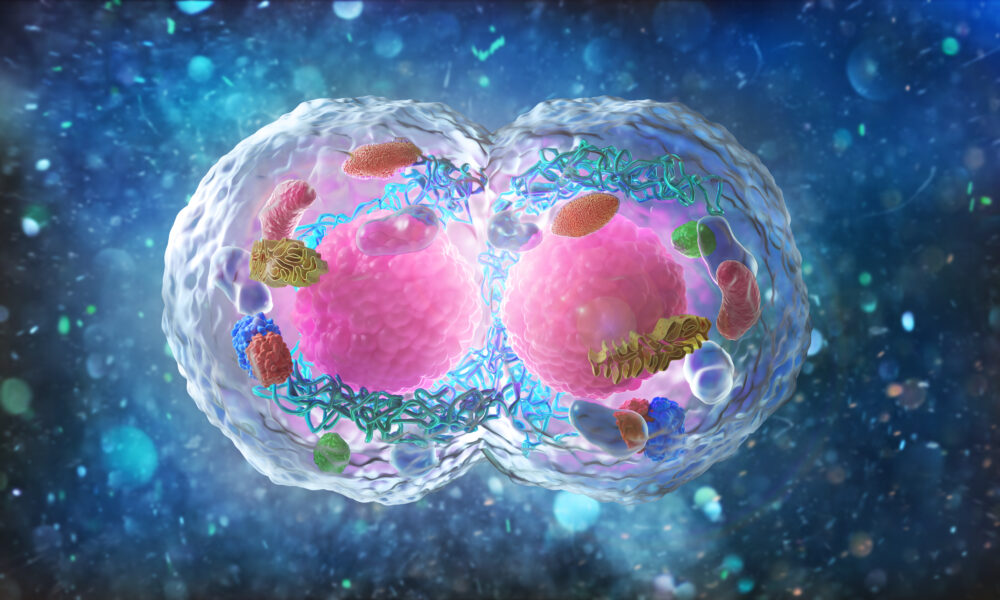
In a universe of non-living space and matter, life is incredibly rare. And in order to stay alive, humans and other organisms have to overcome a myriad of engineering challenges. Just how is this done? And more to the point, is an evolutionary process capable of producing the solutions to these many challenges? On today's episode, host Andrew McDiarmid concludes his conversation with Dr. Howard Glicksman, co-author with engineer Steve Laufmann of the new book Your Amazing Body. The book explores some of your body’s greatest marvels, including how your hearing and vision work, how you coordinate your movements, and — perhaps the greatest miracle of them all — how you developed from a single cell at conception. In Part 2, Dr. Glicksman dives into some examples of the countless challenges life must overcome. This is Part 2 of a two-part conversation. Read More ›
Is the human body a cosmic accident, or is it the handiwork of a master engineer? Today on ID The Future, host Andrew McDiarmid begins a two-part conversation with physician Dr. Howard Glicksman, co-author with engineer Steve Laufmann of the new book Your Amazing Body, a fresh, abridged version of their previous book Your Designed Body. In Part 1 of the conversation, Dr. Glicksman begins by contrasting unguided material causes (Darwinism) with intentional intelligent causes, emphasizing that intelligent design better explains the intricate, interdependent coherence found within the human body. He argues that Darwinian evolution only describes how life looks, failing to explain the complex functional capacity, control systems, and engineering principles required for life to actually work and survive. This is Part 1 of a two-part conversation. Look for Part 2 in a separate episode. Visit www.idthefuture.com for more episodes! Read More ›
How is the job of a scientist similar to the job of an attorney? And how do you define evidence? On this ID The Future, host Casey Luskin continues his conversation with attorney and former Colorado House of Representatives member Barry Arrington about the arguments for intelligent design marshaled in Arrington’s book Unforgetting God. In this concluding segment, Arrington and Luskin review common objections to intelligent design and discuss the larger philosophical, cultural, and legal implications of the debate over intelligent design and materialism. Read More ›
Attorneys are skilled in evaluating evidence for claims and making complex ideas easier to understand, two skills that come in handy when assessing scientific theories as well. Today, Dr. Casey Luskin begins a conversation with attorney and former Colorado House of Representatives member Barry Arrington to discuss the evidence for intelligent design and his new book Unforgetting God. In Part 1 of the conversation, Arrington lays out several key arguments for intelligent design and assesses their evidential strength. This is Part 1 of a two-part conversation. Read More ›
Is it possible to produce mathematicians today of the same caliber as greats like Sir Isaac Newton and James Clerk Maxwell? How can we help young people develop a genuine interest in mathematics, including its history, applications, and philosophy? Today on ID The Future, host Andrew McDiarmid concludes his conversation with mathematics educator, curriculum designer, and medical physicist Amos Tarfa. In Part 1, Amos profiled 19th century Scottish mathematician and physicist James Clerk Maxwell to help us better understand the great scientist’s contributions and how they relate to today’s debate over evolution and intelligent design. Here in Part 2, Amos tells us more about his vision for math education and how we can train up the next generation of James Clerk Maxwells. Read More ›
Could you explain irreducible complexity to a friend? How about firing off three reasons you believe it to be true? You never know when you'll be asked to explain your scientific worldview to a family member, friend, or associate. The real question: are you ready? On this ID The Future, we get another chance to learn from biochemist Dr. Michael Behe. Here, Dr. Behe discusses his journey into the field of biochemistry, his key concept of irreducible complexity, and the distinctions between intelligent design and creationism. The conversation also explores scientific and philosophical objections to intelligent design, the implications of Darwinian evolution, and the significance of recent scientific advancements in understanding life's complexity. This interview originally aired on the Truthful Hope podcast. Read More ›
For over 20 years, Evolution News has offered readers exclusive daily news and commentary on the evidence for intelligent design and the debate over evolution. Now, with a fresh design, a broader vision, and new name, Evolution News has become Science and Culture Today. On this episode of ID The Future, host Andrew McDiarmid discusses the rebrand with two key architects of the new website, Discovery Institute's Director of Communications Rob Crowther and our Director of Media & Brand Nathan Jacobson. Discussion covers the history of the site from its beginnings in 2004 to the rationale and features of the new site, along with the importance of scientific discernment. Visit the new site at www.scienceandculture.com. Read More ›
If evolutionary psychology explains every complex human behavior as well as its opposite, does it really explain anything? Today, host Andrew McDiarmid concludes his conversation with geologist and attorney Dr. Casey Luskin about which scientific theory of origins best explains human altruism, cooperation, and morality. McDiarmid recently engaged in some lively discussion under his recent article exploring scientific worldview in the Marvel universe. Specifically, some readers claimed evolution can explain human kindness, heroism, and teamwork. So McDiarmid turned to Luskin, who has spent time researching human origins as well as attempts to explain the origin of human behaviors. Here in Part 2, the pair zoom into altruism to see if evolution can adequately explain it. This is Part 2 of a two-part conversation. Read More ›
Do evolutionary models adequately account for the reality of human altruism, moral conviction, and cooperation? Does intelligent design offer a better explanation? On this ID The Future, host Andrew McDiarmid begins discussing these questions and more with geologist and attorney Casey Luskin. McDiarmid's recent article exploring scientific worldview in the Marvel universe generated some lively back-and-forth in the comments section, particularly about whether evolutionary processes could account for humans looking out for other humans. Luskin tackles the question head-on, putting it in the larger context of evolutionary psychology's penchant for explaining every possible human behavior through the lens of a Darwinian past. This is Part 1 of a two-part conversation. Look for Part 2 in a separate episode. Read More ›
By now, you might think that the icons of evolution that Dr. Jonathan Wells wrote about 24 years ago have been put out of our misery. And indeed, much has changed, and these icons have even less ground to stand on than they did back then. But they don’t call them icons for nothing! Whatever else they are, they’re stubborn, and it’s not uncommon to see evidence of them still popping up in popular science articles, cartoons, movies, and even scientific journals. On this episode of ID The Future, host Andrew McDiarmid welcomes back freelance science reporter David Coppedge to give us a few recent examples of the icons of evolution that keep shambling along, including recent sightings of the peppered moth myth and the Miller-Urey experiments. Read More ›